# Heated Jacket vs Heated Vest: 2026 B2B Product Guide for Workwear & Outdoor Brands
If you’re a B2B buyer evaluating which heated apparel product to add to your brand’s lineup, you’ve probably asked the same question we get from every new client: “Should I start with a heated jacket or a heated vest?” As a heated apparel brand owner, workwear distributor, or private label program manager, the answer depends on four factors — your target market, your price band, your distribution channel, and your existing SKU mix.
This guide is built for you. We’ll walk through a side-by-side comparison of heated jacket and heated vest across heating zones, battery life, mobility, target market, MOQ, and per-unit cost. By the end, you’ll have a clear framework for choosing the right product for your brand — and a decision tree you can use with your factory sourcing team.
—
1. The Quick Answer
| If your target buyer is… | Start with… | Why |
|---|---|---|
| Construction / industrial workers | Heated jacket | Arms + torso coverage, durable shell, higher output |
| Hunters / anglers | Heated vest | Mobility, layered under waders or outer shell |
| Office / commute / lifestyle | Heated vest | Lower retail price, fits under blazer or business casual |
| Motorcycle / motorsport | Heated jacket | Wind protection + arm heating on highway |
| Ski resort / snow sports | Heated jacket | Snow + wind + cold = full coverage needed |
| Senior citizens / arthritis | Heated vest | Easier to put on, less restrictive, lower retail |
| Outdoor enthusiasts (multi-activity) | Heated jacket | Versatile across more use cases |
| Gift / promotional market | Heated vest | Lower MOQ, lower price, higher gift appeal |
If your brand already has a heated jacket SKU, add a heated vest as a complementary product. If you don’t have either, start with a heated jacket unless your target market is specifically the gift / lifestyle segment.
—
2. Heating Zones: Where Each Product Delivers Warmth
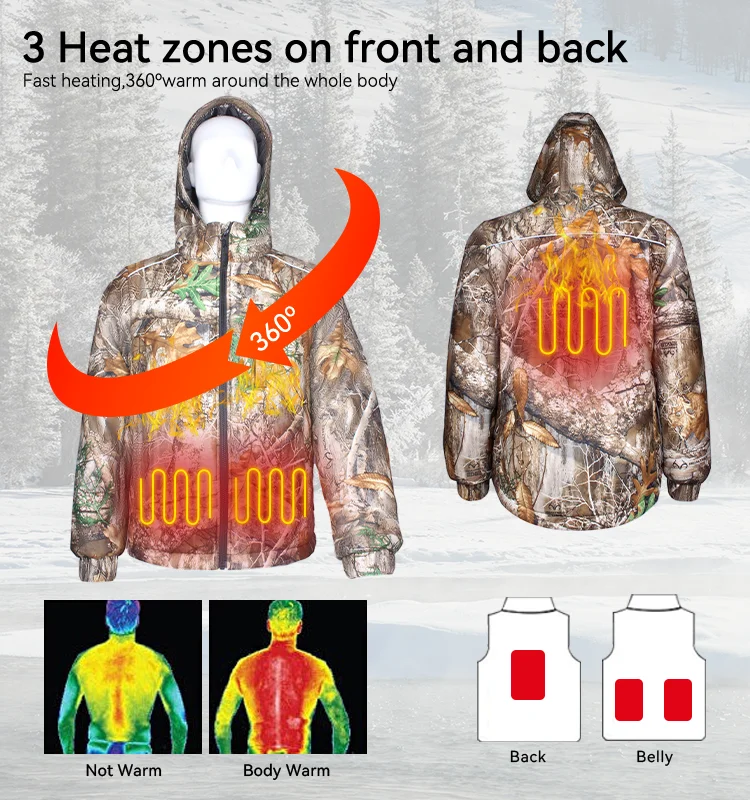
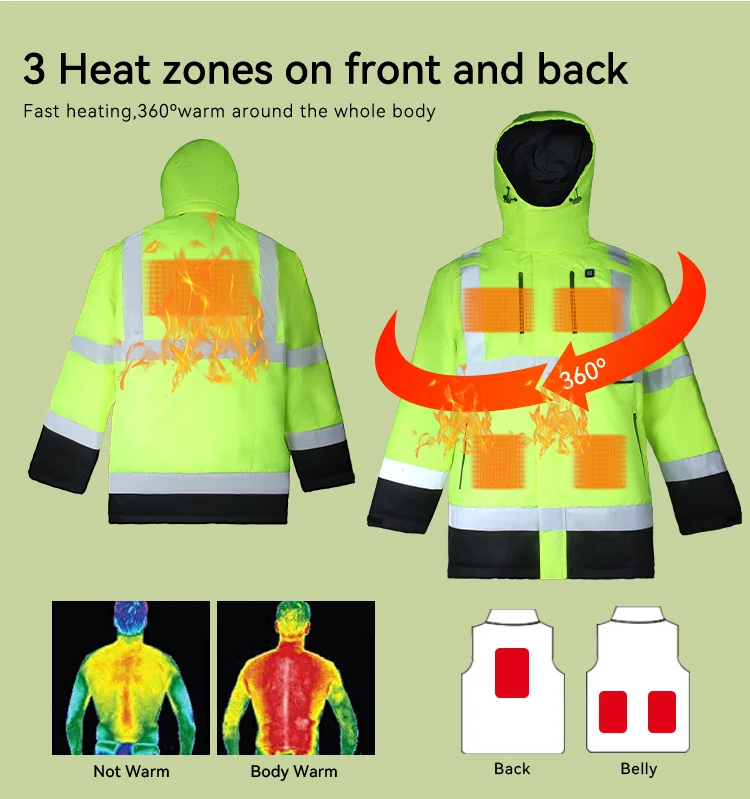
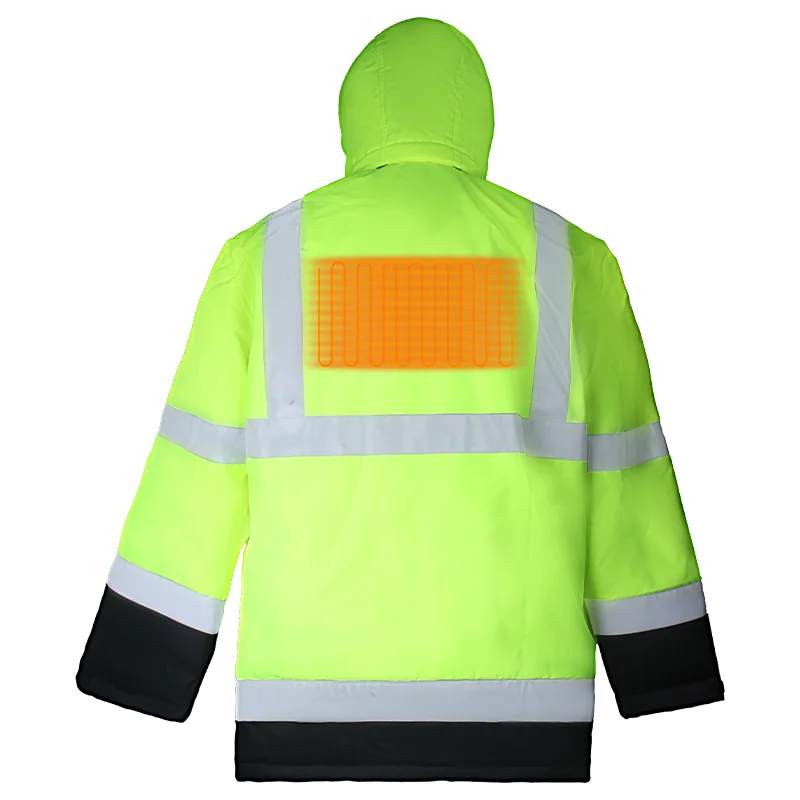
The fundamental engineering difference between a heated jacket and a heated vest is the coverage map. A heated jacket covers the full torso + both arms. A heated vest covers only the core torso. For B2B buyers, the question is: which zones does your target buyer actually need?
| Heating zone | Heated jacket | Heated vest |
|---|---|---|
| Left chest | ✅ | ✅ |
| Right chest | ✅ | ✅ |
| Upper back | ✅ | ✅ |
| Lower back | ✅ | ✅ |
| Collar | ✅ (optional) | ✅ (optional) |
| Left arm | ✅ | ❌ |
| Right arm | ✅ | ❌ |
| Pocket warmers | ✅ (optional) | ✅ (optional) |
| Total zones (typical) | 5-7 | 3-4 |
For B2B buyers, the practical implication: – Heated jacket = 30-40% more heating area = 30-40% more battery drain at the same output level – Heated vest = 3-4 zones = longer battery life OR smaller battery for the same runtime – Heated jacket typically uses 7.4V battery (more power needed for arms) – Heated vest typically uses 5V or 7.4V (lower power, more flexibility)
—
3. Battery Life Comparison: Real Runtime at 0°C
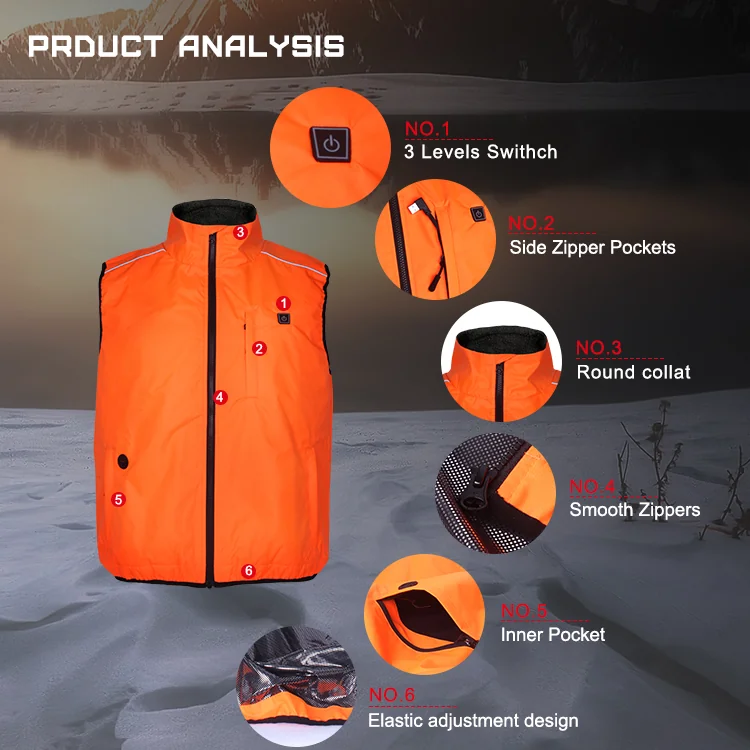
Battery life is where the vest pulls ahead. A heated vest with a 5V 10,000mAh battery delivers 6-8 hours of low-heat output — significantly longer than a heated jacket at the same battery size, because the vest has fewer zones to power.
| Battery | Product | Low heat | Medium heat | High heat |
|---|---|---|---|---|
| 5V 10,000mAh | Heated vest (3 zones) | 6-8h | 3-5h | 2-3h |
| 5V 10,000mAh | Heated jacket (5 zones) | 3-5h | 2-3h | 1-2h |
| 7.4V 5,000mAh | Heated vest (4 zones) | 5-7h | 3-4h | 2-3h |
| 7.4V 5,000mAh | Heated jacket (7 zones) | 3-4h | 2-3h | 1.5-2h |
| 7.4V 10,000mAh | Heated vest (4 zones) | 10-12h | 5-7h | 3-4h |
| 7.4V 10,000mAh | Heated jacket (7 zones) | 6-8h | 4-5h | 2-3h |
For B2B buyers, the takeaway: a heated vest at 7.4V 10,000mAh delivers the same 6-8 hour runtime as a heated jacket at 7.4V 10,000mAh, but the vest’s per-unit cost is 30-40% lower. If your target market values long runtime, vest is the better engineering choice at the same price band.
> B2B Soft Plant #1: Our factory’s heated vest line includes 3-zone, 4-zone, and 5-zone configurations, all compatible with a 7.4V 10,000mAh battery that delivers 10-12 hours of low-heat output. We can ship a custom-branded sample pair in 7 days and a 300-piece trial order in 30-35 days.
—
4. Mobility and Comfort: When Less Coverage Is More
A heated vest is significantly more mobile than a heated jacket. The arms-free design lets the wearer do physical work without the bulk of sleeves, and a vest layers cleanly under an outer shell or business casual jacket.
| Factor | Heated jacket | Heated vest |
|---|---|---|
| Arm mobility | Restricted (full sleeves) | Full freedom |
| Layering flexibility | Outer layer only | Under blazer, fleece, or shell |
| Weight (typical) | 1.2-1.8 kg with battery | 0.5-0.9 kg with battery |
| Packability | Bulky | Compresses to fist-size |
| Put-on difficulty | Higher (full garment) | Lower (slip over head) |
For B2B buyers, the mobility difference matters most in: – Hunting / fishing — vest under waders, no sleeve bulk when shouldering a rifle – Office / commute — vest under blazer, no “outdoor gear” appearance in meetings – Senior / arthritis — easier to put on, less restrictive on stiff shoulders – Gym / cross-training — vest over base layer, full arm mobility
For construction, motorcycle, and ski use, the jacket’s full coverage wins. For everything else, the vest’s mobility advantage is the deciding factor for many end users.
—
5. Target Market and Retail Price Bands
| Product | Primary target | Retail price band | FOB price range (2026 Q2) |
|---|---|---|---|
| Heated jacket (5V entry-level) | Gift, lifestyle, light outdoor | $79-129 | $14-22 |
| Heated jacket (7.4V mid-tier) | Workwear, motorcycle, ski, daily | $129-199 | $22-35 |
| Heated jacket (7.4V premium) | Industrial, premium outdoor | $199-329 | $35-58 |
| Heated vest (5V entry-level) | Gift, senior, lifestyle | $59-99 | $10-18 |
| Heated vest (7.4V mid-tier) | Hunting, commute, layering | $89-149 | $16-25 |
| Heated vest (7.4V premium) | Performance outdoor, fitness | $149-249 | $25-40 |
For B2B buyers, the price band is where the decision crystallizes: – Retail $59-99 = vest only (jacket can’t hit this price without severe quality compromise) – Retail $79-129 = entry jacket OR premium vest – Retail $129-199 = mid-tier jacket OR premium vest – Retail $199+ = premium jacket only
If your target retail is under $100, the heated vest is the only viable option. If your target retail is $100-200, you can choose either based on the mobility vs. coverage decision. If your target retail is $200+, the heated jacket is the natural choice.
—
6. MOQ and Lead Time: Which Is Easier to Launch?
| Factor | Heated jacket | Heated vest |
|---|---|---|
| Standard MOQ | 300 pcs | 200 pcs |
| Custom MOQ | 500 pcs | 400 pcs |
| Sample lead time | 5-7 days | 5-7 days |
| Bulk lead time | 30-40 days | 25-35 days |
| Sample cost | $35-60/pc | $25-45/pc |
| Per-color MOQ | 100-150 pcs | 80-120 pcs |
The heated vest has a structural MOQ advantage: lower piece count, lower per-color minimum, faster bulk lead time. For B2B buyers testing a market, the vest is the lower-risk path.
> B2B Soft Plant #2: Our heated vest program offers 200-piece standard MOQ — 33% lower than our heated jacket program — and 25-35 day bulk lead times (vs. 30-40 days for jackets). For B2B buyers validating a new SKU, our recommendation is a 200-piece vest trial order, followed by a 500-piece jacket second order once the brand is established.
—
7. 5 Common B2B Buyer Mistakes When Choosing Between Jacket and Vest
Mistake #1: Choosing jacket because “more coverage = better.” Coverage isn’t always better. A vest is more mobile, more layerable, and easier to put on. For your target market, less coverage may be the right answer.
Mistake #2: Specifying 7.4V for a vest when 5V is sufficient. A 5V vest battery is smaller, lighter, and cheaper. The runtime is actually longer for a 3-zone vest on 5V than on 7.4V. Don’t over-spec the battery.
Mistake #3: Launching both jacket and vest simultaneously. Manage the SKU count. Start with one, validate the market, then add the second. A 300-piece jacket + 200-piece vest first program = 500 pieces spread across two SKUs with no clear winner.
Mistake #4: Ignoring the price band math. If your target retail is $79, the vest is your only option. Don’t try to hit $79 with a jacket — you’ll compromise on battery, heating element, or shell quality.
Mistake #5: Not testing the mobility difference. A 5-minute factory video doesn’t show the real mobility advantage of a vest. Order samples of both, wear them for a day, then decide.
—
8. The 4-Question Decision Tree for B2B Buyers
| Question | If yes | If no |
|---|---|---|
| Q1: Is your target retail under $100? | Choose vest | Continue |
| Q2: Does your buyer need arm heating (motorcycle, ski, construction)? | Choose jacket | Continue |
| Q3: Will your buyer layer the product under other clothing? | Choose vest | Continue |
| Q4: Is your target market gift, senior, or office lifestyle? | Choose vest | Choose jacket |
If you answered “vest” to any of these, vest is your starting product. If you answered “jacket” to Q2, jacket is required regardless of other answers.
—
9. FAQ — Heated Jacket vs Heated Vest
Q1: Which is better for cold-weather work — jacket or vest?
A: Jacket for full outdoor work (construction, motorcycle, ski). Vest for indoor cold (warehouses, garages) or layered under outer gear.
Q2: Can a heated vest replace a heated jacket?
A: No. A vest doesn’t heat the arms. For sustained cold below -10°C, a jacket’s arm coverage is essential.
Q3: What is the typical retail price difference between jacket and vest?
A: A heated jacket retails 30-50% higher than a comparable vest, reflecting the additional material, heating zones, and battery capacity.
Q4: Which has better battery life — jacket or vest?
A: Vest, because it has fewer zones to power. A 5V 10,000mAh battery runs 6-8 hours on a 3-zone vest vs 3-5 hours on a 5-zone jacket.
Q5: Which is easier to private label — jacket or vest?
A: Vest. Lower MOQ (200 vs 300 pieces), faster lead time, lower per-unit cost, simpler customization.
Q6: Is a heated vest suitable for motorcycle riding?
A: Not recommended as primary heat source. Motorcycle riders need arm heating and wind protection — a jacket is the right choice. A vest can be a complementary layer.
Q7: Which product is better for senior citizens?
A: Vest. Easier to put on, less restrictive, lower retail price, sufficient for indoor cold and short outdoor walks.
Q8: Can I bundle jacket and vest in one program?
A: Yes. Many B2B buyers launch a combined program (300 jacket + 200 vest = 500-piece combined MOQ) to hit better pricing tiers.
Q9: Which is more popular in the corporate gifting market?
A: Vest, due to lower retail price and broader appeal. Jacket gifts are typically reserved for premium / executive gifting.
Q10: What is the most common B2B buyer mistake when choosing?
A: Choosing jacket because “more is better.” For most target markets, a well-specified vest is the better product.
—
10. Conclusion: The Right Heated Apparel Product for Your Brand
The choice between heated jacket and heated vest comes down to your target market, your retail price band, and your distribution channel. A vest wins on mobility, MOQ, lead time, and price. A jacket wins on coverage, warmth, and premium positioning. For B2B buyers new to heated apparel, start with a vest, validate the market, then add a jacket as a premium SKU.
> Ready to start? Request a heated jacket and heated vest sample comparison by emailing [email protected] or via WhatsApp +86-13751041535. We respond to all serious B2B inquiries within 24 hours, and a side-by-side sample pair can be on its way to your office within 7 days.
Browse our heated jackets collection for more B2B product insights, or contact us directly to discuss which product fits your brand’s positioning.
—
This article is part of our B2B heated apparel product guide series. For more comparisons (jacket vs hoodie, glove vs mitten, vest vs base layer), subscribe to our editorial newsletter or contact us directly.