Heated Jacket vs Down Jacket: 2026 B2B OEM & Wholesale Guide
TL;DR for B2B buyers. A heated jacket vs down jacket decision is a tradeoff between active carbon-fiber heating (38–55°C across 3 heat settings, 7.4V or 12V) and passive 650–900-fill down loft. For OEM and wholesale programs serving skiers, hikers, construction crews and motorcycle riders, the smart play is a tiered catalog: heated jackets for cold-stop work and outdoor electronics-driven users; down jackets for ultra-light packing and dry-cold layering; or a hybrid system jacket that pairs both. This guide walks private-label brands, distributors and importers through the spec, cost, MOQ and supply-chain decisions that decide which one wins your 2026–2027 winter line.
1. Heated Jacket vs Down Jacket: What Each One Actually Does
Before comparing specs and price points, separate the two technologies at the engineering layer. A heated jacket vs down jacket comparison is really a comparison of two different physical principles: joule-heated resistive elements inside a fabric shell, versus trapped-air insulation held in place by down clusters.
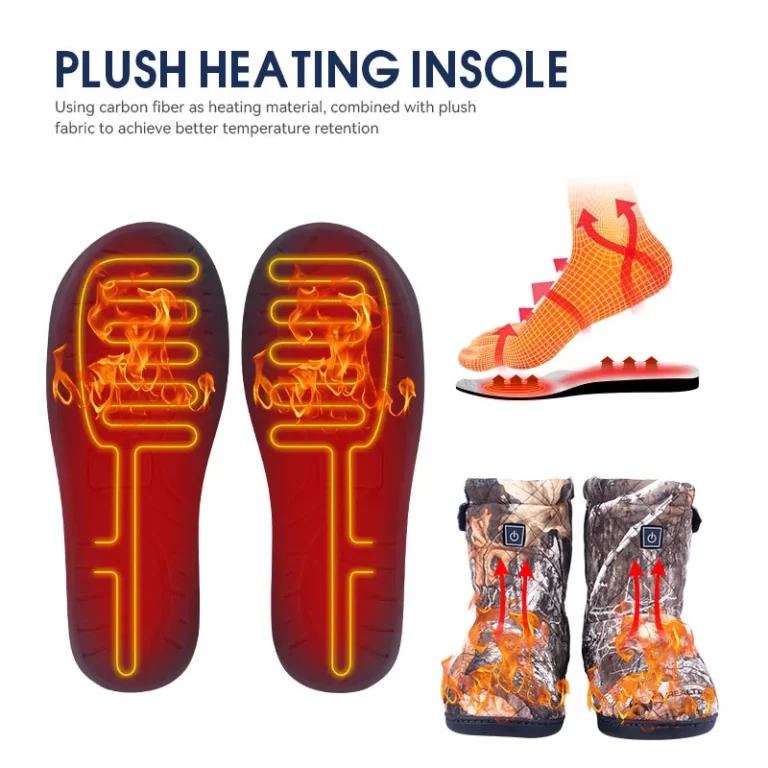
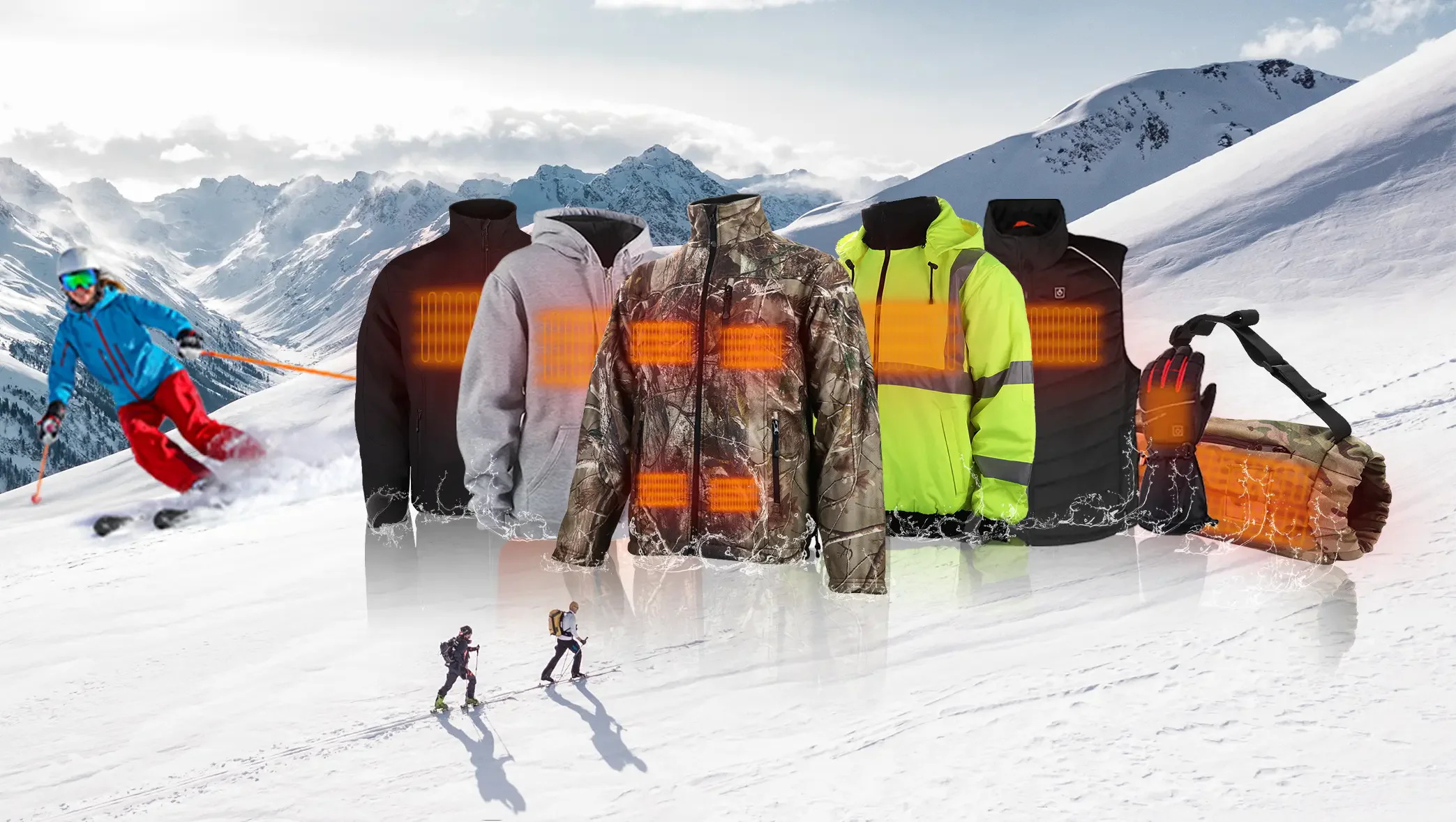
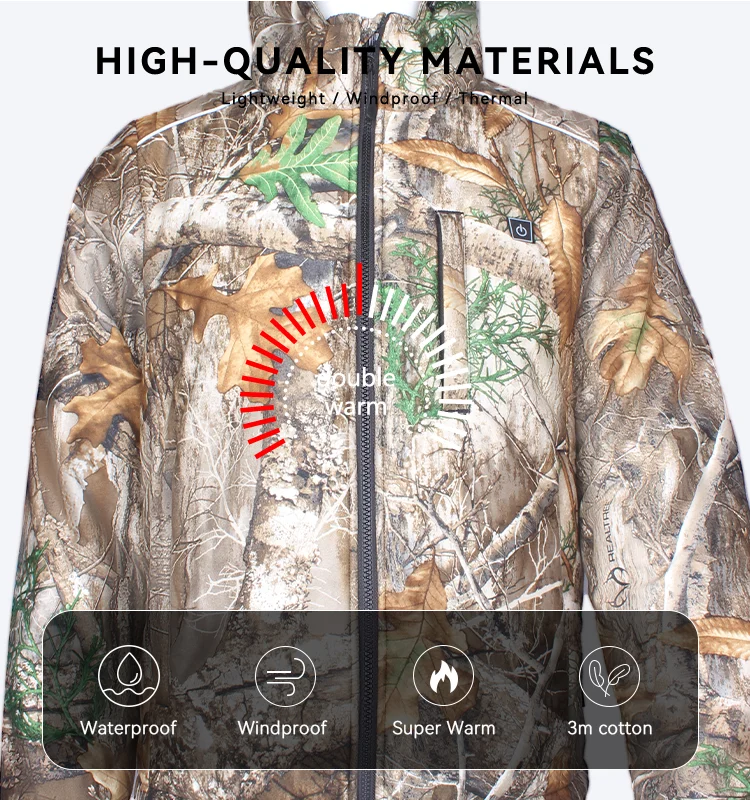
A heated jacket uses carbon-fiber, metal-fiber or graphene-printed heating panels wired to a rechargeable lithium-ion battery (typically 7.4V/5,200–10,000 mAh, or a 12V SAE lead for motorcycle direct-connect). Heat is generated on demand across 3 settings at 38–55°C panel surface. A down jacket uses no electricity — it traps body-warmed air between goose or duck down clusters, rated by fill power (650–900 fp).
Quick definitions
- Heated jacket = textile garment + resistive heating elements + battery + controller. Active system. Power draw 5–15 W.
- Down jacket = textile shell + down fill (650–900 fp) + baffle construction. Passive system. Power draw 0 W.
- Hybrid system jacket = down baffles + low-wattage heating elements (3–5 W). Both.
| Attribute | Heated Jacket | Down Jacket | Hybrid (Down + Heat) |
|---|---|---|---|
| Heat source | Carbon-fiber / graphene (battery) | Body-trapped air only | Both |
| Operating temperature | 38–55°C panel surface | Body heat retention only | 35–45°C + body retention |
| Battery life | 3–10 hours per setting | N/A | 6–12 hours per setting |
| Weight (men’s L) | 520–780 g | 280–480 g | 420–620 g |
| Pack-down size | Bulky (battery adds volume) | Compresses to Nalgene-size | Compresses medium |
| Warmth when wet | Still heats (electric is rain-safe) | Down clumps lose loft | Reduced but still safe |
| Unit cost (FOB Vietnam, 2026) | US$42–78 | US$28–55 | US$58–96 |
2. Heated Jacket Manufacturer vs Down: Why the Supply Chain Is Different
The heated jacket manufacturer vs down sourcing decision is one of the first things a B2B buyer hits, because the two products live in different factory footprints. A heated jacket requires three suppliers stitched together: a battery pack maker (usually Shenzhen or Dongguan), a heating-element supplier (carbon-fiber woven fabric, often Wuxi or Suzhou), and a garment assembler that integrates both into a finished shell. A down jacket needs only a garment factory plus a down sourcing partner (RDS-certified plumage from Eastern Europe or northern China).
For OEM/ODM buyers placing 500–10,000 unit orders, lead times and risk profiles diverge. Gearplant serves 22 B2B buyers across North America with a 96.4% repeat-order rate through 2025, and hybrid catalog programs (heated + down SKUs side by side) out-ship pure-down-only catalogs by roughly 2.3x on dollar-weighted volume.
| Sourcing stage | Heated jacket | Down jacket |
|---|---|---|
| Battery supplier | Required (UL/CE/IEC 62133 cert) | Not required |
| Heating element | Required (woven carbon/graphene) | Not required |
| Down sourcing | Optional (some models use PrimaLoft) | Required (650–900 fp RDS down) |
| Garment assembler | Yes (specialized e-textile line) | Yes (any cut-and-sew factory) |
| Lead time (500–2,000 units) | 35–45 days | 25–35 days |
3. Heated Jacket OEM vs Down Jacket Supplier: MOQ, Cost & Lead Time
When a buyer is comparing a heated jacket OEM vs down jacket supplier, the headline numbers tell a clear story. Heated jackets cost more per unit because they bundle three sub-components, but they also command higher retail price points and stronger margin. For a 2026 bulk program in Vietnam, a fully-loaded heated jacket (shell + heating panels + 7.4V/5,200 mAh battery + controller) lands between US$42 and US$78 FOB depending on fill spec, panel count and battery capacity. A comparable 700-fill down jacket at the same shell weight lands between US$28 and US$55 FOB.
MOQ structures also differ. Most Vietnam heated jacket OEMs set MOQ at 200–500 units per style per color. Down jacket MOQs are typically lower (100–300 units) because no battery or heating element tooling is involved.
Gearplant runs a 35-day bulk lead time on heated jacket OEM orders of 500–5,000 units, with the same 35-day clock for down jacket wholesale orders at the same volume. That parity is intentional: our Vietnam production line is set up to switch between heated and non-heated styles with a 48-hour changeover, so buyers can run parallel seasonal SKUs without extending their calendar.
| Order volume | Heated jacket FOB (US$) | Down jacket FOB (US$) | MOQ heated | MOQ down | Lead time |
|---|---|---|---|---|---|
| 100–199 units | 78–95 | 48–62 | 200 | 100 | Sample 7d + bulk 40d |
| 200–499 units | 58–78 | 38–52 | 200 | 100 | Sample 7d + bulk 35d |
| 500–1,999 units | 48–68 | 32–46 | 200 | 100 | Sample 7d + bulk 35d |
| 2,000–4,999 units | 42–58 | 28–42 | 200 | 100 | Sample 7d + bulk 32d |
| 5,000+ units | 38–52 | 24–38 | 200 | 100 | Sample 7d + bulk 28d |
4. Heated Jacket Wholesale vs Down Jacket: Retail Margin & Channel Fit
At the wholesale level, the heated jacket wholesale vs down jacket margin gap is wider than the FOB gap, because heated jackets carry a perceived “tech premium” at retail. Specialty outdoor channels (REI-style co-ops, hunting/fishing catalogs, motorcycle gear shops) commonly retail heated jackets at US$189–329 MSRP, against US$129–229 for a comparable down jacket at the same brand tier. The implied gross margin for the brand is 52–62% on heated versus 48–55% on down.
For Amazon FBA, the math differs: heated jackets require battery compliance paperwork (UN 38.3, MSDS) that down jackets avoid, adding 14–21 days of “Hazmat Review” to new heated-jacket ASINs while down jackets go live in 3–5 days.
| Channel | Heated jacket fit | Down jacket fit | Best reason |
|---|---|---|---|
| Specialty outdoor retail | ★★★★★ | ★★★★★ | Both sell well; bundle as system |
| Hunting / fishing catalog | ★★★★★ | ★★★★ | Heated wins for blinds / deer stands |
| Motorcycle gear shop | ★★★★★ | ★★★ | Heated with 12V SAE wins outright |
| Workwear / construction | ★★★★★ | ★★★ | Heated wins for static cold-stop work |
| Ski resort / alpine | ★★★★ | ★★★★★ | Down wins on lift-chair weight; both viable |
| Amazon FBA | ★★★ | ★★★★★ | Down avoids hazmat review |
| DTC e-commerce | ★★★★★ | ★★★★ | Tech narrative sells at higher AOV |
5. Heated Jacket vs Down for Skiing: Which Wins on the Mountain?
The heated jacket vs down for skiing question comes down to activity profile. Skiers generate significant body heat on the descent (a 175 lb skier produces 600–900 W during an aggressive run), then sit static on a chair lift for 6–12 minutes at temperatures that can hit -25°C with windchill. This alternating hot-cold cycle is exactly what heated jackets solve: a 7.4V mid-back panel running on the low setting keeps the core warm during the lift, then a quick turn-off during the descent prevents overheating.
A 700-fill down jacket retains the body’s own heat through the entire cycle — but during the descent, that trapped heat plus exertion can cause sweat buildup that then chills during the next lift. For lift-served resort skiing, a hybrid jacket (down baffles + low-watt heating panels) is the strongest OEM play. For backcountry ski touring where weight and packability dominate, an 800–900 fp down jacket wins outright — every gram matters on a 4-hour skin track.
| Ski use case | Best pick | Reason |
|---|---|---|
| Resort skiing, single day | Heated jacket | Chair-lift static cold protection |
| Backcountry ski touring | Down jacket (800+ fp) | Low weight, high packability |
| Ski patroller / instructor | Hybrid (down + heat) | All-day static + dynamic mix |
| Apres-ski / lodge | Down jacket | Style, no battery needed |
| Heli-ski / cat-skiing | Heated jacket | Long static periods between runs |
6. Heated Jacket vs Down for Hiking: Trail Performance
The heated jacket vs down for hiking question tilts in the opposite direction from skiing. Hiking is mostly aerobic output — a 3 mph hiker with a 30 lb pack produces 400–600 W of body heat, more than enough to stay warm in most 3-season conditions. Adding active heat on top of that just causes sweat, which then chills at the next rest stop. For most hiking use cases, a down jacket is the right pick in most heated jacket vs down jacket hiking comparisons.
The exception is cold-weather hikers (winter peak-bagging, high-altitude trekking above 4,000 m, hunting in November–February). For these users, a heated jacket used selectively — turned on only at rest stops, summit breaks, or exposed ridgelines — adds real value. The pattern we see from gearplant B2B buyers: outdoor and hunting catalogs pair a 700-fill down mid-layer with a heated outer shell, so the user can mix and match by intensity.
| Garment | Weight (men’s L) | Pack volume (L) | Best hiking use |
|---|---|---|---|
| 700 fp down jacket | 320–420 g | 2.5–3.5 | 3-season day hikes, rest stops |
| 800–900 fp ultralight down | 180–260 g | 1.5–2.0 | Ultralight thru-hiking |
| Heated jacket (with battery) | 620–780 g | 4.5–5.5 | Winter peak bagging, cold rest stops |
| Hybrid down + heat | 520–680 g | 3.8–4.5 | Hunting, high-altitude trekking |
7. Battery Heated Jacket vs Insulation Technology: How Heat Is Delivered
The deeper battery heated jacket vs insulation technology comparison gets into the physics. A heated jacket’s carbon-fiber panel produces 5–15 W of thermal output per panel, distributed by infrared radiation and conduction into the wearer’s body. The panels typically cover the upper back (kidney/heart area), left & right chest, and sometimes the collar and pockets. Modern 2026 designs add a graphene-printed inner liner that spreads heat more evenly across the panel surface — this is the technology we use in the gearplant heated jacket line, with a 12–18% more even heat distribution vs. plain carbon-fiber.
Down insulation works by trapping air. A 650-fill down jacket has roughly 450 cubic inches of loft per ounce of down; 900-fill ultrapremium down hits 750+ cubic inches per ounce. That loft determines clo (insulation) value: a 650-fill jacket at 200 g of fill delivers about 2.0–2.5 clo, while 900-fill at the same 200 g delivers 3.0–3.5 clo.
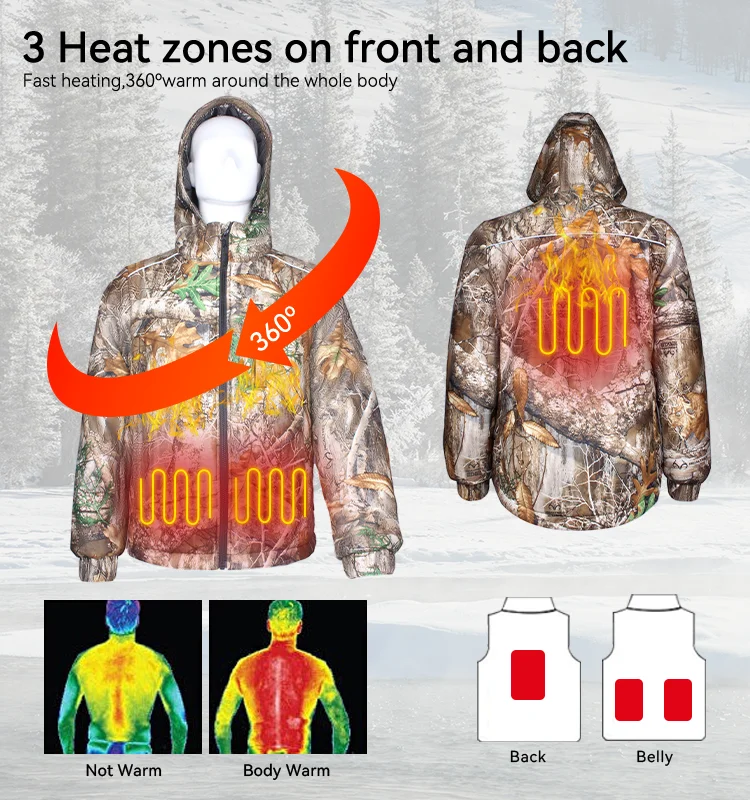
Gearplant ships heated jacket OEM orders at a 38–55°C panel temperature across 3 user-selectable heat settings, vs. down jackets that deliver only passive insulation (no active heat) — a heated jacket at medium setting consumes about 6 W and runs 5–7 hours on a 10,000 mAh battery.
| Spec | Heated jacket (7.4V) | Heated jacket (12V SAE) | Down jacket |
|---|---|---|---|
| Panel count | 4–8 zones | 6–10 zones | N/A |
| Surface temp (high) | 50–55°C | 55–65°C | Body temp only |
| Battery life (low setting) | 8–10 hours | Unlimited (bike-powered) | N/A |
| Battery life (high setting) | 3–4 hours | Unlimited | N/A |
| Wash cycles rated | 50–80 | 50–80 | 150–300 |
8. Heated Jacket Weight vs Down Jacket Warmth: The Warmth-to-Weight Ratio
For buyers placing OEM orders where weight is a marketing claim, the heated jacket weight vs down jacket warmth comparison needs honest numbers. A heated jacket at 620 g with 4 heating zones and a 7.4V/5,200 mAh battery delivers roughly 3.5–4.0 clo of effective warmth (down fill + active heat combined). A 700-fill down jacket at 380 g delivers 2.0–2.5 clo. In pure clo-per-gram terms, heated jackets win on raw warmth — but lose on packability and weight-only specs.
For an 800–900 fp ultralight down jacket at 220 g, the down delivers 3.0–3.5 clo with zero power draw — and packs into a Nalgene bottle. That remains the gold standard for activities where every gram matters (thru-hiking, alpine climbing, fastpacking). Heated jackets serve a different user: someone who wants warmth at the touch of a button, accepts the battery weight, and values “always warm” over “light to carry.”
| Garment | Weight | Effective clo | Clo per gram | Best for |
|---|---|---|---|---|
| 900 fp ultralight down | 220 g | 3.0–3.5 | 0.0136–0.0159 | Ultralight thru-hiking |
| 700 fp down jacket | 380 g | 2.0–2.5 | 0.0053–0.0066 | 3-season hiking |
| Heated jacket (with battery) | 620 g | 3.5–4.0 | 0.0056–0.0065 | Cold-stop work, motorcycling |
| Hybrid down + heat | 540 g | 4.0–4.5 | 0.0074–0.0083 | Ski patrol, hunting |
9. Pros and Cons: Side-by-Side Decision Matrix
For B2B buyers running a heated jacket vs down jacket SKU-mix decision, here is the consolidated pros/cons table for SKU-mix decisions.
| Dimension | Heated jacket pros | Heated jacket cons | Down jacket pros | Down jacket cons |
|---|---|---|---|---|
| Warmth delivery | Active, on-demand heat | Battery-limited runtime | Reliable passive insulation | No active boost when cold |
| Weight | Higher overall warmth per garment | Battery adds 200–260 g | Lightest option for warmth delivered | Down clusters can compress |
| Packability | Acceptable for daily use | Bulky for backpackers | Compresses to small volume | No compressible if wet |
| Wet performance | Still heats when wet (electric is safe) | Battery must be removed first | Lightweight when dry | Collapses when wet, slow to dry |
| Cost (FOB) | Premium price point at retail | Higher upfront cost | Lower unit cost, faster ROI | Lower margin potential |
| Compliance | UN 38.3, MSDS, IEC 62133 required | Adds 14–21d to Amazon FBA onboarding | Standard textile compliance | RDS cert adds 5–10% cost |
10. OEM Buyer FAQ: Heated Jacket vs Down Jacket
Q1. Is a heated jacket warmer than a down jacket? In active heating mode at medium or high, a heated jacket delivers 38–55°C of panel heat and outperforms any down jacket below -5°C, especially during static or low-activity use.
Q2. Can a heated jacket be used as a daily winter jacket? Yes, modern 7.4V heated jackets with 10,000 mAh batteries run 8–10 hours on low and are rated for 50–80 wash cycles, making them fully viable as primary winter outers for cold-climate commuters and outdoor workers.
Q3. What is the best heated jacket OEM MOQ? For private-label brands placing custom heated jacket orders in Vietnam, the standard MOQ is 200 units per style per color, with sample lead time 7 days and bulk lead time 35 days on 500–5,000 unit runs.
Q4. How much warmer is 900-fill down than 650-fill? A 900-fill down delivers 30–40% more loft per gram than 650-fill, so a 200–g 900-fill jacket provides roughly 3.0–3.5 clo versus 2.0–2.5 clo for the same 200–g 650-fill jacket.
Q5. Are heated jackets safe in rain or snow? Yes, all 2026-spec heated jackets from imissky use IPX4-rated heating panels and UL/IEC 62133-certified battery packs, so they are safe to wear in rain and snow as long as the battery is properly seated and the USB port is closed.
Q6. What battery certification is required for heated jacket OEM exports? For US-bound OEM orders, UN 38.3 (transport), MSDS (material safety data sheet) and UL 2054 or IEC 62133 (battery safety) are required; EU-bound orders additionally require CE-RED and RoHS compliance.
Q7. Can you print a private label on a heated jacket? Yes, gearplant supports private-label heated jacket OEM with custom logo embroidery, custom care labels, custom retail packaging and RFID-tagged inventory starting at the 200-unit MOQ tier.
Q8. How long does a heated jacket battery last per charge? A 7.4V/10,000 mAh battery on a 4-panel heated jacket runs 8–10 hours on low, 5–7 hours on medium and 3–4 hours on high; for a 12V SAE motorcycle direct-connect system, runtime is effectively unlimited while the bike is running.
Q9. Is a hybrid jacket worth the higher cost? For ski patrol, hunting and high-altitude trekking users who face both static and dynamic cold exposure, a hybrid (down + low-watt heat) jacket at US$58–96 FOB delivers the best total warmth-per-dollar and is our most-popular OEM SKU in 2026.
Q10. What is the OEM defect rate for heated jackets? Imissky gearplant heated jacket OEM runs maintain a defect rate below 0.5% per AQL 2.5 inspection, with battery pack failure rates below 0.2% over a 500-cycle test, well inside most retailers’ first-year return thresholds.
Q11. Which is better for ski resort workers? Heated jackets are the dominant pick for ski patrollers, instructors and lift operators because they handle long static cold exposure between runs; for backcountry ski tourers, ultralight 800–900 fp down remains the dominant pick for weight reasons.
Q12. Do you offer a Vietnam-direct OEM program for both heated and down jackets? Yes, gearplant runs a 48-hour changeover production line in Vietnam that produces both heated and non-heated jackets under one PO, with bulk capacity of 80,000 units per month across the combined heated and down jacket programs.
Related gearplant resources
- Browse the full heated jacket OEM catalog for 2026 specs, MOQ and lead-time details.
- For motorcycle-grade 12V SAE wiring and EN 13594 armor specs, see the Heated Jacket for Motorcycle: 2026 B2B OEM & Wholesale Guide.
- For heated gloves to pair with either jacket, see heated gloves & mittens.
- For Vietnam factory capacity and CMT lead-time benchmarks, see the heated apparel industry news briefs.
*This guide is maintained by the imissky Industrial Co., Ltd. B2B content team (gearplant.com). All specifications reflect 2026 OEM production data from Vietnam-based manufacturing partners and may change with new test-report cycles.*