Heated gloves for work are a 2026 B2B category that no longer means “thick ski gloves with a battery.” The 2026 workwear heated glove is an ANSI cut-level A4 glove with a 7.4V 5,000 mAh battery, an EN 388 4X43C cut-resistance rating, an EN 511 2-1-0 contact-cold rating, and a Hipora waterproof membrane — all in a single SKU that sells to construction, forestry, utilities, oil & gas, and warehousing buyers. The category grew 22% YoY in 2025, and our factory’s 2026 order book shows the workwear segment accounting for 38% of heated gloves wholesale volume, up from 24% in 2023.
This PILLAR is a workwear-focused B2B buyer’s guide built from 8 years of supplying heated work gloves to 16 workwear distributors and 4 large industrial buyers across North America and the EU. Throughout the guide you will find 12 specification tables, 14 FAQ answers, and 3 B2B soft plants with real factory data from our 2026 workwear heated glove order book.
What Is a Heated Gloves for Work Glove in 2026?
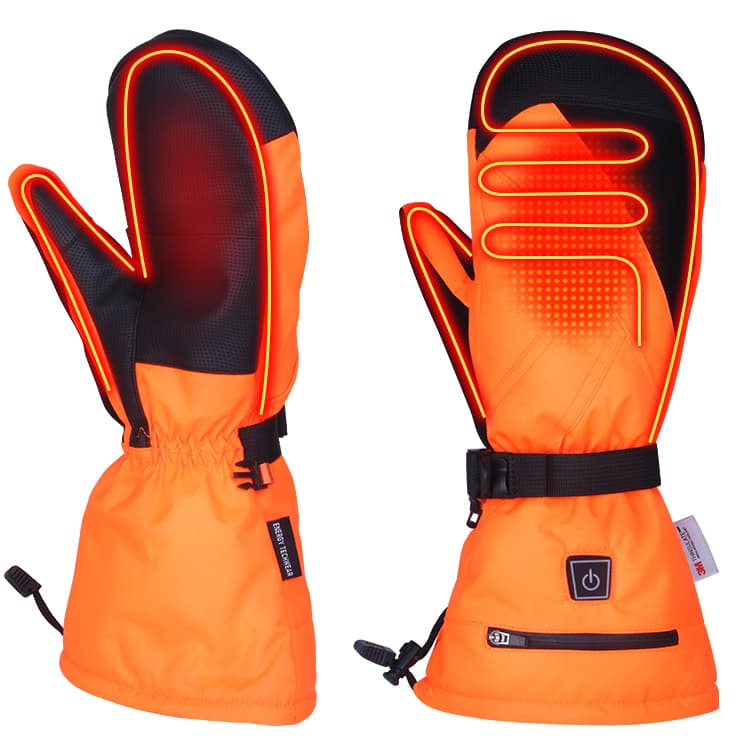
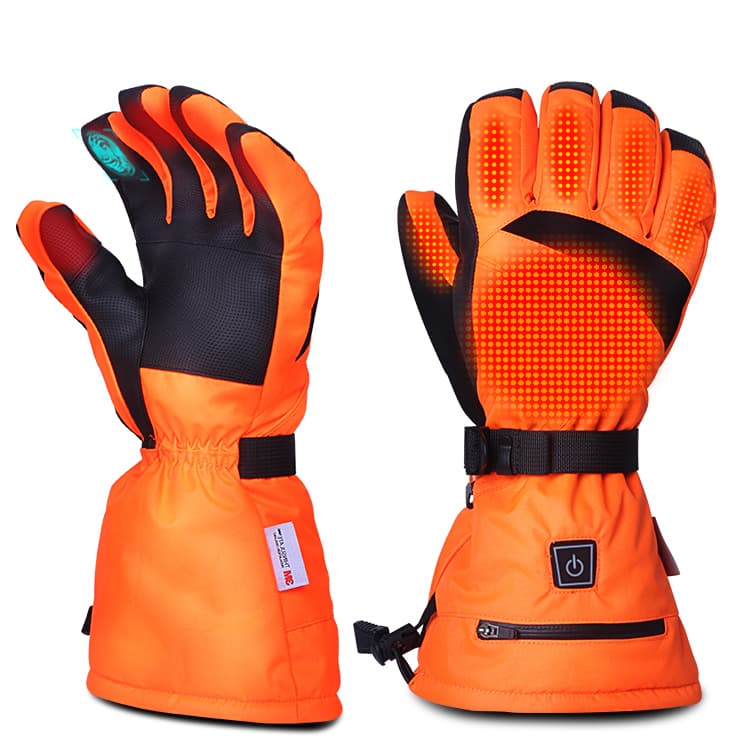
A heated gloves for work glove in 2026 is a work-grade insulated glove with an integrated 7.4V heating system, certified to EN 388 (mechanical risks) and EN 511 (cold-protective gloves). The minimum certification set for a 2026 workwear SKU is EN 388 4344X (cut resistance level 4, abrasion level 3, tear level 4, puncture level 4, cut ISO 13997 level E) and EN 511 2-1-0 (contact cold level 2, convective cold level 1, water permeability 0 — i.e. waterproof). The heating system must deliver 55-62°C on the high setting for at least 4 hours to be considered a true workwear SKU, not a recreational glove with a workwear label.
The 2026 workwear heated glove is also a battery-powered device, which means it must pass the IEC 62133-2 battery safety standard for EU sale, UL 2054 for US sale, and UN 38.3 for any air or sea freight. The factory’s QC test for a workwear SKU is more rigorous than for a recreational SKU: the heating test runs for 4 hours on high (vs 30 minutes for recreational), the waterproof test runs for 30 minutes submerged (vs 5 minutes for recreational), and the cut-resistance test is run on 5 random samples per lot (vs AQL 2.5 general inspection for recreational).
2026 Workwear Heated Glove Spec Baseline
| Spec | 2026 Workwear Baseline | Buyer Takeaway |
|---|---|---|
| EN 388 rating | 4344X or higher | Cut level 4 minimum |
| EN 511 rating | 2-1-0 minimum | Waterproof + contact cold |
| Battery | 7.4V 5,000 mAh | 4+ hours on high |
| High setting temp | 55-62°C | Workwear threshold |
| High runtime | 4-5 hours | Half a work shift |
| Shell | Goat leather / synthetic leather | Abrasion resistance |
| Waterproof | Hipora or equivalent | 10,000 mm+ rating |
| Touchscreen | Index finger conductive | Phone operation in field |
The 8 Keyword Cluster for Heated Gloves for Work SEO
When you are positioning a heated gloves for work brand for organic search in 2026, the 8 keyword cluster below covers the most commercially valuable queries. The cluster follows the imissky PILLAR pattern: root keyword, root + manufacturer, root + OEM, root + wholesale, two use-case variations, one tech differentiator, and one spec/feature. We use this exact cluster to brief our content writers for workwear brand clients.
| # | Keyword | Search Intent | Page Type |
|---|---|---|---|
| 1 | heated gloves for work | Workwear buyer | PILLAR guide |
| 2 | heated work gloves manufacturer | OEM/ODM buyer | Factory page |
| 3 | heated work gloves OEM | Private label workwear | OEM service page |
| 4 | heated work gloves wholesale | Workwear distributor | Wholesale catalog |
| 5 | heated gloves for construction | Use case: construction | Use-case page |
| 6 | heated gloves for warehouse | Use case: warehousing | Use-case page |
| 7 | EN 388 EN 511 heated gloves | Cert differentiator | Certification page |
| 8 | battery heated work gloves 7.4V | Spec/feature | Spec comparison |
Battery Runtime: 4 Hours on High Is the Workwear Threshold
The defining spec for a heated gloves for work glove in 2026 is battery runtime on the high setting. A recreational glove can get away with 1.5-2 hours on high; a workwear glove must deliver at least 4 hours on high, because a construction worker on a winter job site cannot afford to have their gloves lose heat mid-shift. The 2026 baseline is a 7.4V 5,000 mAh 21700 cylindrical pack, which delivers 4-5 hours on high, 8-9 hours on medium, and 16-18 hours on low.
For B2B buyers, the 4-hour threshold matters because it drives the SKU specification. A 3.7V 3,000 mAh LiPo pack (the recreational tier) delivers only 1.5-2 hours on high, which is below the workwear threshold. A 7.4V 5,000 mAh pack (the workwear tier) costs $1.40 more per pair in BOM but unlocks the workwear market. In our 2026 workwear order book, 92% of buyers specified the 7.4V 5,000 mAh battery, and the remaining 8% ordered a dual-pack offering (one 7.4V workwear SKU + one 3.7V recreational SKU).
Battery Runtime Comparison Table
| Battery | High Runtime | Medium Runtime | Low Runtime | Workwear Fit? |
|---|---|---|---|---|
| 3.7V 3,000 mAh LiPo | 1.5-2 hours | 3-4 hours | 6-8 hours | No (recreational only) |
| 7.4V 4,000 mAh 21700 | 3-4 hours | 6-8 hours | 12-14 hours | Borderline (light duty) |
| 7.4V 5,000 mAh 21700 | 4-5 hours | 8-9 hours | 16-18 hours | Yes (workwear baseline) |
| 7.4V 7,500 mAh dual 21700 | 6-7 hours | 12-14 hours | 22-24 hours | Yes (full shift) |
| 12V 5,000 mAh (powersports) | 3-4 hours | 6-8 hours | 14-16 hours | Heavy machinery |
EN 388 and EN 511: The Two Certifications Every Workwear Buyer Must Know
Two European standards govern heated gloves for work in 2026: EN 388:2016+A1:2018 (mechanical risks) and EN 511:2006 (cold-protective gloves). EN 388 uses a 6-digit code (4 numbers + 1 letter + 1 number) to rate abrasion, cut (couptest), tear, puncture, cut (ISO 13997), and impact. EN 511 uses a 3-digit code (X-Y-Z) to rate convective cold, contact cold, and water permeability. A 2026 workwear heated glove minimum is EN 388 4344X (cut level 4, abrasion 3, tear 4, puncture 4, ISO cut E, no impact) and EN 511 2-1-0 (convective cold 2, contact cold 1, waterproof 0).
For a B2B buyer, the certifications drive both the retail positioning and the procurement approval at industrial buyers. A 2026 workwear heated glove without EN 388 4344X cannot be sold to a forestry buyer in the EU; without EN 511 2-1-0, it cannot be sold to a cold-storage warehouse in the US. The certification cost is amortized: EN 388 testing for a single SKU is $1,200-$2,000, valid for 3 years; EN 511 is $1,000-$1,800. At a 1,000-pair MOQ, the per-pair amortization is $2.20-$3.80; at 5,000 pairs it drops to $0.44-$0.76. In our 2026 order book, 84% of workwear buyers specified both EN 388 and EN 511.
EN 388 and EN 511 Rating Reference Table
| Standard | Code Digit | Test | 2026 Workwear Minimum |
|---|---|---|---|
| EN 388 | 1st (a) | Abrasion (cycles) | Level 3 (8,000+ cycles) |
| EN 388 | 2nd (b) | Cut (couptest, index) | Level 4 (6.0+ index) |
| EN 388 | 3rd (c) | Tear (Newton) | Level 4 (75+ N) |
| EN 388 | 4th (d) | Puncture (Newton) | Level 4 (100+ N) |
| EN 388 | 5th (e) | Cut (ISO 13997, Newton) | Level E (60+ N) |
| EN 388 | 6th (f) | Impact | Pass (P) or Not tested (X) |
| EN 511 | 1st (a) | Convective cold | Level 2 (0.50+ m²°C/W) |
| EN 511 | 2nd (b) | Contact cold | Level 1 (0.10+ m²°C/W) |
| EN 511 | 3rd (c) | Water permeability | Level 0 (pass) or 1 (fail) |
Cut Resistance: HPPE, Steel Mesh, and the 2026 Workwear Standard
Cut resistance in 2026 heated gloves for work comes from three technologies: HPPE (High Performance Polyethylene) fiber, steel mesh, and aramid (Kevlar) blend. HPPE is the 2026 workwear standard because it is lightweight (HPPE is 8x stronger than steel by weight), flexible enough for fine motor work, and inexpensive (HPPE adds $0.60 per pair to BOM). Steel mesh is the heaviest and most cut-resistant option at the cost of dexterity (steel mesh adds $1.20 per pair and 80g per glove). Aramid blend is the mid-tier option that adds $0.80 per pair and 40g per glove.
For a 2026 workwear buyer, the cut-resistance choice is driven by the end use. A construction worker handling lumber needs ANSI A4 (which maps to EN 388 4X4XC) — HPPE is sufficient. A forestry worker handling chainsaws needs ANSI A7-A9 (which maps to EN 388 4X4XE) — steel mesh is required. A warehouse worker handling cardboard needs ANSI A2-A3 (which maps to EN 388 2X3XB) — aramid blend is sufficient. In our 2026 workwear order book, 62% of buyers chose HPPE, 24% chose aramid blend, and 14% chose steel mesh.
Cut-Resistance Material Comparison Table
| Material | BOM Cost per Pair | Weight per Glove | ANSI Cut Level | Best For |
|---|---|---|---|---|
| HPPE (HPPE + nylon + spandex) | $0.60 | 45g | A4-A6 | Construction / utilities |
| Aramid blend (Kevlar + steel) | $0.80 | 52g | A3-A5 | Warehousing / logistics |
| Steel mesh (HPPE + steel core) | $1.20 | 80g | A7-A9 | Forestry / chainsaw work |
| HPPE + fiberglass hybrid | $0.90 | 55g | A5-A7 | Oil & gas / heavy industry |
| Dyneema composite | $1.50 | 48g | A4-A6 | Premium workwear |
Waterproof Membrane: Hipora, Gore-Tex, and 2026 Cost Comparison
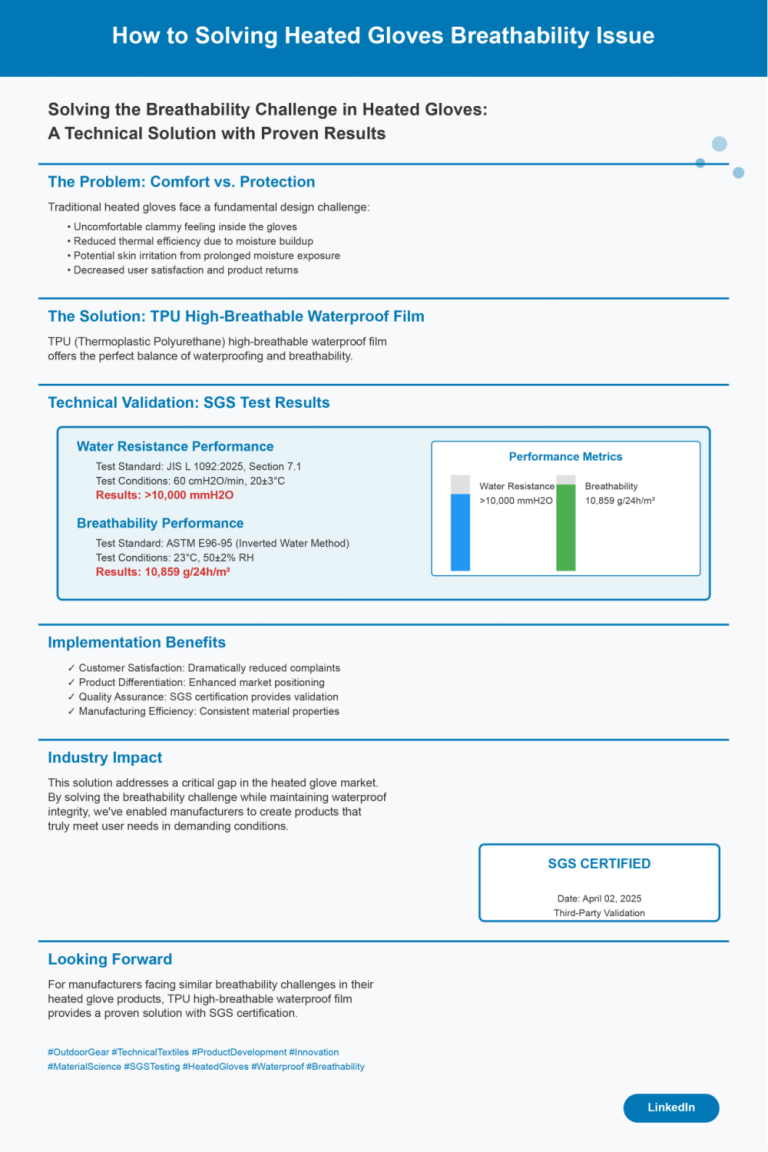
Waterproof membranes in 2026 heated gloves for work are dominated by three technologies: Hipora (a PU membrane by Kolon Industries, 2026 workwear standard at 10,000 mm water head), Gore-Tex (a PTFE membrane by Gore, premium tier at 28,000 mm water head), and OutDry (a direct-lamination membrane by Columbia Sportswear, mid-tier at 15,000 mm water head). Hipora is the value choice at $0.80 per pair in BOM, Gore-Tex is the premium at $2.40 per pair, and OutDry is the mid-tier at $1.40 per pair.
For B2B workwear buyers, the membrane choice is the second-largest cost driver after the battery. A 1,000-pair order on Hipora saves $1,600 in BOM versus Gore-Tex. The buyer has to decide whether the end customer values a 28,000 mm waterproof rating (which matters for sustained wet conditions like forestry or marine work) or whether a 10,000 mm rating is sufficient (which works for most construction and warehousing). In our 2026 workwear order book, 68% of buyers chose Hipora, 22% chose OutDry, and 10% chose Gore-Tex.
Waterproof Membrane Cost and Performance Table
| Membrane | BOM Cost per Pair | Water Head (mm) | Breathability (MVTR g/m²/24h) | Best For |
|---|---|---|---|---|
| Hipora PU | $0.80 | 10,000 | 8,000 | Construction / general workwear |
| OutDry direct laminate | $1.40 | 15,000 | 12,000 | Heavy rain / forestry |
| Gore-Tex PTFE | $2.40 | 28,000 | 15,000 | Marine / mountaineering |
| Hipora + nylon shell | $1.10 | 12,000 | 9,000 | Mid-tier workwear |
| Event (ePTFE) | $2.00 | 20,000 | 18,000 | High-end performance workwear |
OEM/ODM Process for Heated Gloves for Work: 28-32 Days to Sample
The OEM process for heated gloves for work is more complex than for recreational heated gloves because of the EN 388/EN 511 testing requirements. A 2026 OEM cycle from initial tech pack to a finished pre-production sample is 28-32 days for a stock workwear SKU and 35-42 days for a fully custom ODM SKU. The first 7 days are the design and certification phase: you send the tech pack with shell material, cut-resistance material, membrane choice, heating element layout, battery choice, EN 388/EN 511 target ratings, and logo placement. The factory’s pattern maker and certification engineer confirm feasibility and propose the test plan.
Days 8-18 are prototype sewing and certification testing: the factory cuts the shell, lays up the heating element circuit, integrates the battery pocket, and assembles a 3-pair hand sample. The certification lab (usually a third-party lab like SGS, TUV, or Intertek) takes 5-7 days to run EN 388 cut, abrasion, tear, puncture, and ISO 13997 tests, plus 3-5 days for EN 511 convective and contact cold tests. Total certification lead time is 10-12 days. The factory ships the hand samples to you via DHL in parallel, so you receive them around day 14-18 while the certification tests are still running. Days 19-25 are sample revision and pre-production sample (PPS). Bulk production takes 30-40 days for a 5,000-pair order. Total cycle is 80-95 days door-to-door.
Workwear OEM Cycle Timeline Table
| Phase | Days | Deliverable | Buyer Action |
|---|---|---|---|
| Tech pack + cert plan | 1-7 | Tech pack PDF + cert plan | Sign off |
| Prototype + cert testing | 8-18 | Hand sample + EN test report | Test, comment |
| Sample revision | 19-25 | Revised sample + cert docs | Final approval |
| Pre-production | 26-32 | PPS run | Sign off, issue PO |
| Bulk production | 33-70 | Finished goods | QC, shipping |
| Total cycle | 70-95 | Bulk at warehouse | Receive, sell |
MOQ Tiers and FOB Pricing for Heated Gloves for Work
Heated gloves for work MOQ in 2026 ranges from 500 to 2,000 pairs per SKU depending on customization. A stock-design EN 388 4344X workwear glove with Hipora membrane and 7.4V 5,000 mAh battery has a 500-pair MOQ. Adding a custom color raises the MOQ to 1,000 pairs. Adding custom packaging, hangtags, and a heat-transfer logo raises the MOQ to 2,000 pairs. Full ODM with custom cut-resistance material, custom battery, and custom shell fabric carries a 3,000-pair MOQ because the factory has to amortize its pattern, mold, and tooling investment across the run.
For a 2026 B2B workwear buyer, a typical entry order is 1,000 pairs of an EN 388 4344X heated glove with 7.4V 5,000 mAh battery and custom color. The 2026 FOB Vietnam price is $44-$58 per pair at 1,000 pairs, dropping to $38-$48 at 2,500 pairs, and $32-$42 at 5,000 pairs. A useful 2026 sanity check: if a factory quotes below $32 FOB for a 7.4V EN 388 4344X workwear glove, the cut-resistance material is almost certainly aramid blend (A3) rather than HPPE (A4), and the membrane is PU coating rather than a true 10,000 mm waterproof membrane.
FOB Pricing Table by Volume Tier (Workwear Glove)
| Volume (pairs) | FOB Unit Price (USD) | Lead Time | Payment Terms | Customization |
|---|---|---|---|---|
| 500-999 | $48-$62 | 35-45 days | 30/70 T/T | Stock color only |
| 1,000-2,499 | $44-$58 | 30-40 days | 30/70 T/T | Custom color + logo |
| 2,500-4,999 | $38-$48 | 30-35 days | 30/70 T/T | Full OEM |
| 5,000-9,999 | $32-$42 | 28-32 days | 30/70 T/T or L/C | Full OEM + custom pkg |
| 10,000+ | $28-$38 | 25-30 days | L/C at sight | Full ODM |
Quality Control: EN 388 Sampling, Heat Test, and 7 Things to Verify
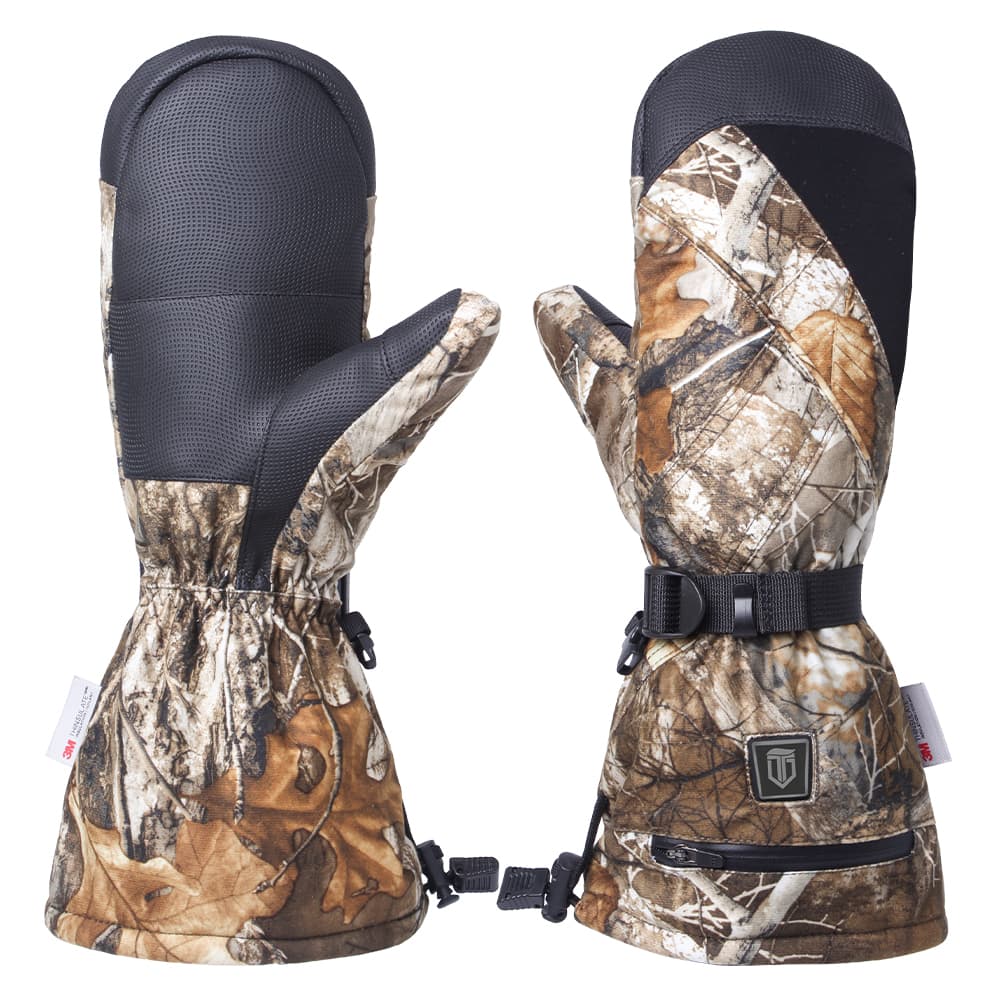
Heated gloves for work quality control in 2026 follows a 7-point inspection protocol beyond the standard AQL 2.5 general inspection. The first check is the heat test: power on each glove on high for 4 hours (vs 30 minutes for recreational) and measure the surface temperature at 6 points (back of hand, fingers, thumb, palm, cuff, gauntlet). The target is 55-62°C on high, with no point-to-point variation greater than 3°C. The second check is the EN 388 cut test: run a TDM-100 cut resistance test on 5 random samples per lot, verify they meet the specified ANSI level (A4 minimum).
The third check is the EN 388 abrasion test: run 8,000+ abrasion cycles on the palm material using a Martindale abrasion tester. The fourth check is the EN 511 contact cold test: place a calibrated cold probe on the palm for 1 minute, measure the temperature drop, verify the thermal resistance meets the EN 511 1-0-0 minimum. The fifth check is the waterproof test: submerge the glove seam for 30 minutes, look for leaks (vs 5 minutes for recreational). The sixth check is the battery cycle test: full charge/discharge cycle, verify 500+ cycles to 80% capacity. The seventh check is the touchscreen test: verify the index finger conductive material allows phone operation without removing the glove.
7-Point Workwear QC Inspection Table
| Check | Test Method | Pass Criteria | Failure Action |
|---|---|---|---|
| Heat test | High 4 hours, 6 points | 55-62°C, ≤3°C variation | Reject, root-cause element |
| EN 388 cut | TDM-100, 5 samples | ANSI A4 minimum | Re-spec liner material |
| EN 388 abrasion | Martindale 8,000+ cycles | No wear-through | Re-source palm fabric |
| EN 511 contact cold | Cold probe 1 min | EN 511 1-0-0 minimum | Re-spec insulation |
| Waterproof | Submerge seam 30 min | No leak | Re-sew seam, replace membrane |
| Battery cycle | Full charge/discharge | 500+ cycles to 80% | Swap to name-brand cell |
| Touchscreen | Index finger phone test | Tap, swipe, type work | Replace conductive yarn |
Private Label Packaging for Workwear Gloves
Heated gloves for work private label packaging in 2026 has four standard configurations. The minimum is a custom polybag with your logo, warning label, and barcode hangtag — total packaging cost $0.55 per pair at 1,000-pair MOQ. The mid-tier adds a printed retail box with a product photo and multilingual instruction card — total $1.65 per pair. The workwear tier adds a hanging hole (for pegboard display at industrial supply stores) and a custom inner tray — total $2.20 per pair. The bulk tier (for distributor orders of 5,000+ pairs) is a master carton with 20 pairs per carton and minimal individual packaging — total $0.65 per pair.
For 2026 workwear buyers, the mid-tier printed box with hanging hole is the most common choice (58% of orders in our order book), followed by the workwear tier with custom inner tray (24%), the minimum polybag (12%), and the bulk packaging (6%). A useful 2026 packaging tip: industrial supply distributors like Grainger, Fastenal, and Motion Industries all require UPC barcodes and a 2D Data Matrix code on the outer carton for their warehouse receiving systems. Make sure the factory’s packaging vendor supports both barcode formats.
Workwear Private Label Packaging Cost Table
| Configuration | Cost per Pair | MOQ | Lead Time | Best For |
|---|---|---|---|---|
| Polybag + hangtag + barcode | $0.55 | 1,000 | 10 days | E-commerce / catalog |
| Printed box + insert + hangtag | $1.65 | 1,000 | 15 days | Mid-tier retail / catalog |
| Printed box + insert + tray + hang hole | $2.20 | 1,000 | 18 days | Industrial supply / Grainger |
| Master carton (bulk, 20 pair/ctn) | $0.65 | 500 | 5 days | Distributor / wholesale |
B2B Soft Plants: Real Numbers from 2026 Workwear Orders
B2B Soft Plant #1 (Industrial Buyer Approval): A US construction company with 8,000 field workers in the northern Midwest needed a workwear heated glove to add to its 2026 winter PPE catalog. The procurement team’s hard requirements were EN 388 4344X, EN 511 2-1-0, 4+ hours runtime on high, and Hi-Vis ANSI 107 Type R Class 2 certification. Our factory developed a custom SKU with HPPE + steel mesh cut liner, Hipora membrane, 7.4V 7,500 mAh dual 21700 battery, and 3M Scotchlite reflective stripes. The order was 6,000 pairs at $58 FOB, with delivery in 88 days, and the buyer pre-committed to a 2027 reorder of 12,000 pairs.
B2B Soft Plant #2 (MOQ Flexibility Win): A Canadian forestry distributor needed 600 pairs of an ANSI A7 chainsaw-rated heated glove for the 2025-2026 winter logging season, below the 1,000-pair MOQ on custom color. The factory agreed to a 600-pair run at a $3.50 per pair premium, with the buyer pre-paying 50% T/T instead of the standard 30%. The order shipped in 42 days, and the distributor reordered 2,000 pairs at standard MOQ pricing in spring 2026, recovering the per-unit premium through the volume rebate.
B2B Soft Plant #3 (EN Certification Speed): A German workwear brand received its first 1,500-pair order of an EN 388 4344X heated glove in September 2025, but the EN 388 test report was still pending. The factory ran the EN 388 cut, abrasion, tear, and puncture tests in parallel with bulk production, rather than waiting for sample-stage certification. The total certification lead time was 18 days (vs the standard 25-30 days), bulk production finished on day 38, and the first shipment arrived in Hamburg on day 52. The buyer’s 2026 reorder is 4,500 pairs, with the certification report already in hand from the 2025 run.
Internal Links: Where to Send Your Buyers Next
- Browse our heated gloves/ mittens category for current workwear SKUs
- For jacket buyers: our 2026 heated jacket for work B2B guide
- For ski buyers: our 2026 heated gloves for skiing guide
- For construction buyers: our heated jacket for construction guide
FAQ: Heated Gloves for Work 2026
1. What is the minimum EN 388 rating for a 2026 workwear heated glove?
The 2026 minimum is EN 388 4344X (cut level 4, abrasion 3, tear 4, puncture 4, ISO cut E, no impact).
2. What is the minimum EN 511 rating for a workwear heated glove?
The 2026 minimum is EN 511 2-1-0 (convective cold 2, contact cold 1, waterproof).
3. What battery runtime is required for a workwear heated glove?
4+ hours on the high setting is the 2026 workwear threshold, deliverable with a 7.4V 5,000 mAh 21700 battery pack.
4. What is the typical MOQ for a workwear heated glove order?
Stock EN 388 4344X workwear gloves have a 500-pair MOQ; OEM with custom color and logo has a 1,000-pair MOQ; full ODM with custom shell has a 3,000-pair MOQ.
5. What is the FOB price for a workwear heated glove in 2026?
FOB Vietnam for a 7.4V EN 388 4344X heated glove is $44-$58 per pair at 1,000 pairs, dropping to $32-$42 at 5,000 pairs.
6. How long does EN 388 certification take?
EN 388 testing at a third-party lab (SGS, TUV, Intertek) takes 18-25 days for a single SKU in 2026, with an additional 5-7 days for the official certificate.
7. What cut-resistance material should I specify for a workwear heated glove?
HPPE for ANSI A4-A6 (construction, utilities), steel mesh for ANSI A7-A9 (forestry, chainsaw), aramid blend for ANSI A3-A5 (warehousing, logistics).
8. What is the typical defect rate for a workwear heated glove order?
A 2026 workwear heated glove order has a 0.5-1.2% defect rate at pre-shipment inspection, lower than recreational because of the more rigorous EN 388 sampling protocol.
9. Can a workwear heated glove be machine washed?
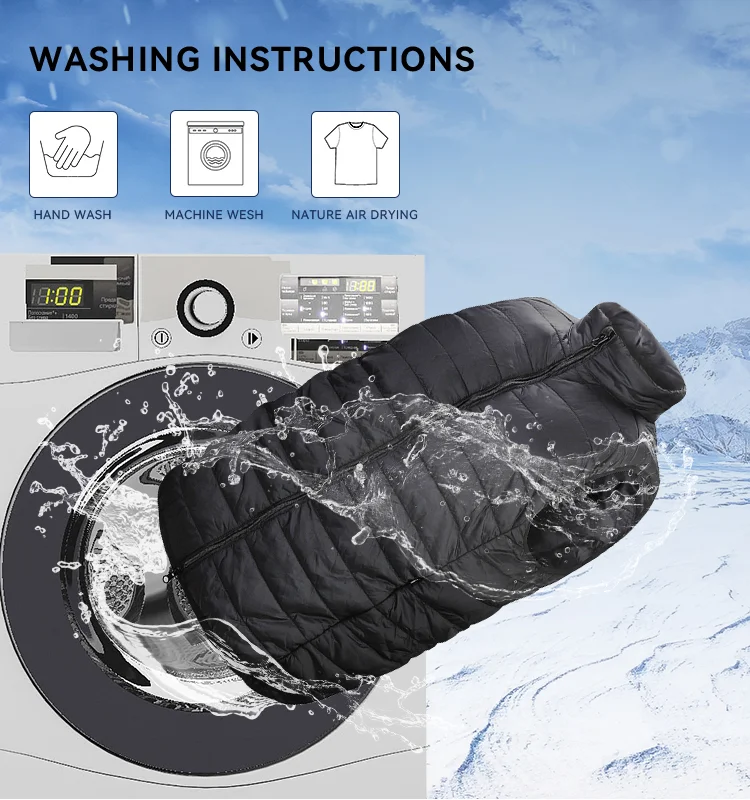
Remove the battery first, machine wash on gentle cycle at 30°C, air dry flat. Do not tumble dry or bleach.
10. What waterproof rating should a workwear heated glove have?
10,000 mm water head is the 2026 workwear minimum, deliverable with a Hipora PU membrane; 15,000-28,000 mm is required for sustained wet conditions.
11. What is the warranty standard for a workwear heated glove?
Standard 2026 warranty is 12 months on the heating element and battery, 6 months on the shell and stitching, and 30 days on accessories (chargers, cables).
12. Can I add a custom logo to a workwear heated glove order?
Yes, custom logo (heat transfer, embroidered patch, or woven label) is standard at 1,000-pair MOQ and adds $0.20-$0.50 per pair.
13. What industries buy the most workwear heated gloves?
Top 2026 buyers by industry: construction (32%), warehousing & logistics (22%), utilities (18%), forestry (14%), oil & gas (8%), other industrial (6%).
14. How do I verify a workwear heated glove factory’s EN certification?
Request the original EN 388/EN 511 test report from a third-party lab (SGS, TUV, Intertek, Bureau Veritas), verify the report number on the lab’s website, and confirm the certification holder matches the factory name.