Heated Jacket for Motorcycle: 2026 B2B Buying Guide for OEM & Wholesale Buyers
TL;DR for buyers. A motorcycle-grade heated jacket for motorcycle riding runs on a fused 12V SAE connector wired directly to the bike’s battery, distributes carbon-fiber or metal-fiber heating panels across the chest, back, sleeves and collar, and carries CE/EN 13594 armor pockets at the elbows, shoulders and back. OEM MOQ starts at 50 pieces per color per size run; sample lead time is 7 days, bulk production lead time 30 days; defect rate below 0.5% per AQL 2.5 inspection; Vietnam manufacturing cuts U.S. landed duty from 36.3% to 9.0% under HTS 6101.30.30. This guide walks private-label brands, distributors and importers through the seven decisions that move a quote from “interesting” to “production-ready.”
1. Why “Heated Jacket for Motorcycle” Is a Distinct B2B Category
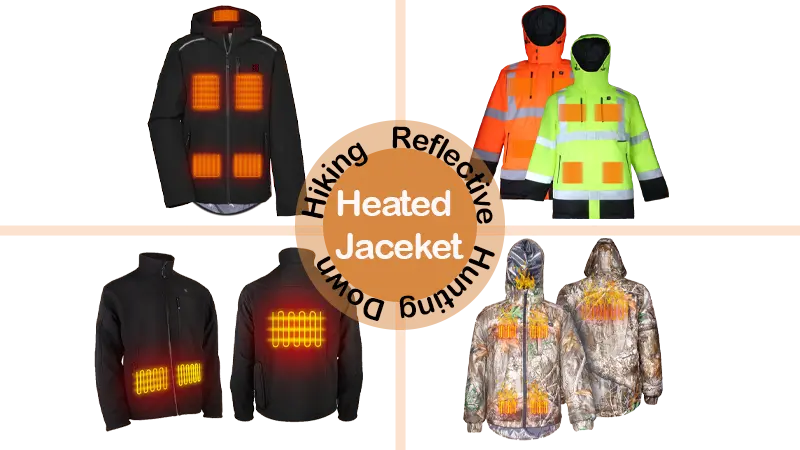
A heated jacket for motorcycle is not a heated workwear jacket with a different label. The thermal, electrical and safety demands diverge in three measurable ways:
- Continuous-vibration endurance. Engine vibration (typically 8–35 Hz, 1–4 g RMS at the handlebars) is a fatigue test that no ski jacket or construction jacket has to pass. Wiring crimps, heating-element adhesion and connector housings must survive 200+ hours of sweep-vibration testing per SAE J1455.
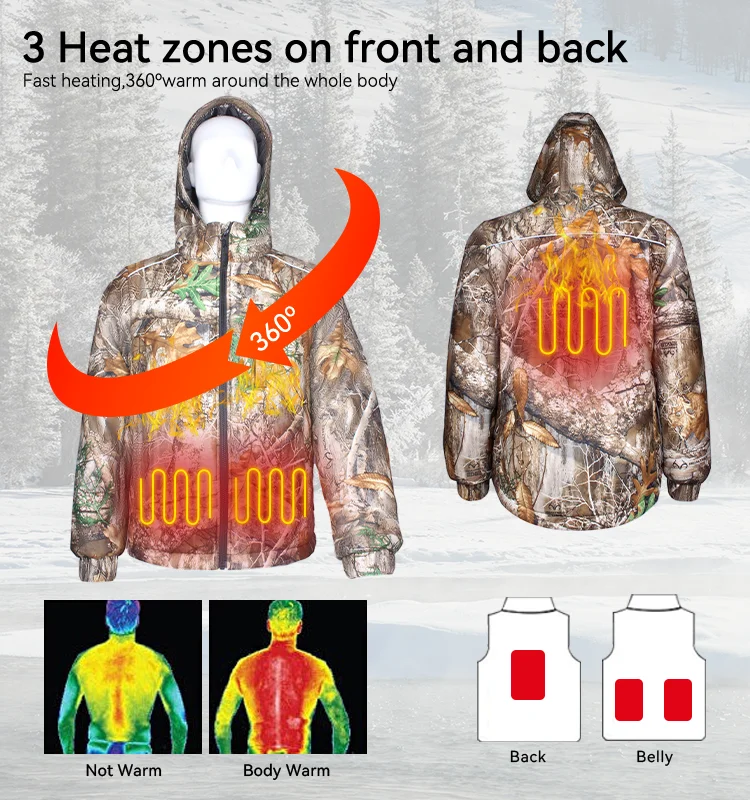
- Aerodynamic + rain load. Touring speeds of 100–130 km/h produce 1.4–2.1 kPa dynamic pressure on the chest panel; combined with sustained rain, the outer shell must hit EN 343 Class 3 hydrostatic head (≥10,000 mm before wash) plus a DWR rating of 90+ after 20 wash cycles.
- Direct 12V battery integration. Rather than running off a swappable Li-ion pack like a ski or hunting jacket, a motorcycle jacket taps fused power from the bike’s battery via a SAE 2-pin or BMW-style DIN/Hella plug, with an in-line 7.5 A fuse and a kill-switch wired through the ignition.
These three differences explain why heated jacket for motorcycle manufacturer sourcing is structurally separate from the workwear-heated-jacket category, and why a B2B buyer’s RFQ should call them out explicitly.
2. Heated Jacket for Motorcycle Manufacturer: How OEM Factories Are Structured
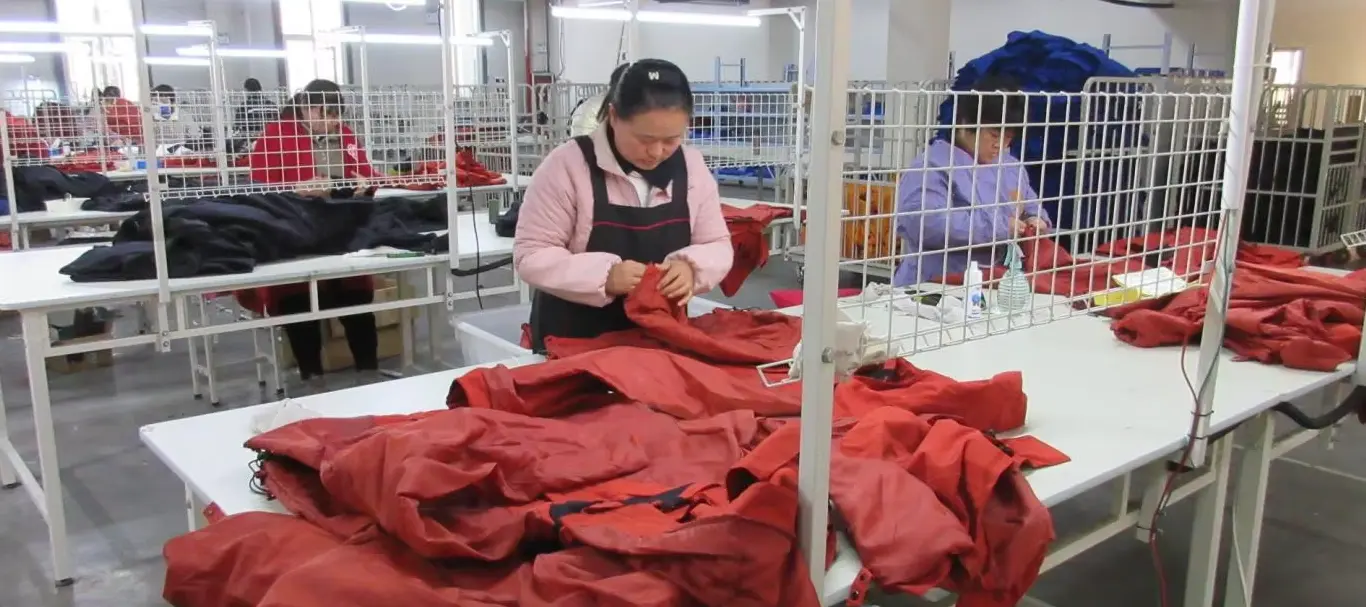
A capable heated jacket for motorcycle manufacturer runs four parallel production lines: shell sewing, heating-element lamination, e-textile wiring harness assembly, and final QC with CE/EN 13594 armor verification. The table below maps the lines a wholesale buyer should expect to see audited.
| Production line | Typical headcount | Output / 8h shift | Key equipment |
|---|---|---|---|
| Shell sewing (outer + liner) | 24 operators | 180–220 jackets | Programmable pattern sewer, bartacker, hot-air seam tape welder |
| Heating-element lamination | 10 operators | 400–500 panels | Hot-melt adhesive press, carbon-fiber sheet cutter |
| Wiring harness assembly | 12 operators | 220 harnesses | IDC crimper, continuity tester, 12V load tester |
| Final assembly + CE/EN 13594 armor pocket QA | 18 operators | 160–200 finished jackets | Armor pocket depth gauge, hi-pot tester, 12V burn-in rack |
B2B soft plant (#1): for OEM orders ≥1,000 units per SKU, expect defect rate below 0.5% on first-article inspection; for orders of 50–500 units, expect 1.0–1.5% with a free replacement clause in the proforma invoice.
Vietnam-based OEM facilities carry an additional structural advantage: textile and apparel clusters in Ho Chi Minh City, Binh Duong and Dong Nai share a common CMT (cut-make-trim) base, which compresses sampling from 14 days to 7 days and lets an experienced manufacturer absorb +20% volume without resourcing new lines.
3. Heated Jacket for Motorcycle OEM: What “OEM” Actually Means in 2026
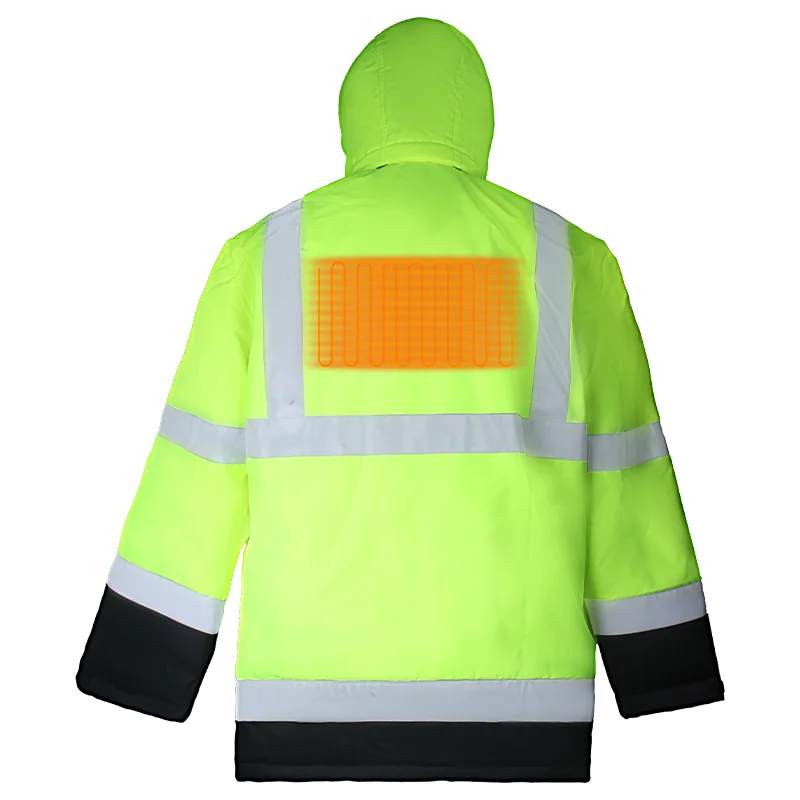
A heated jacket for motorcycle OEM deal in 2026 splits into three contract types, and the line items you negotiate will differ on each.
| OEM contract type | What the factory does | What you provide | Typical MOQ |
|---|---|---|---|
| CMT (Cut, Make, Trim) | Sewing from factory-owned shell fabric, your heating elements | Heating panels, wiring harness, branding | 100 pcs/style |
| ODM (your design, factory’s pattern) | Pattern + sample + bulk from your tech-pack | Tech-pack, branding, packaging | 50 pcs/style |
| Full OEM (private label) | Factory sources shell + lining + elements, you brand it | Logo file, packaging dieline, label copy | 50 pcs/style |
Two contract items are non-negotiable in 2026. First, tooling ownership: when the pattern is developed under an ODM contract, the buyer must hold a written exclusive-use clause for the design — otherwise the factory can sell the same pattern to a competitor after 12 months. Second, element IP: if your RFQ specifies a custom heating-panel layout (e.g. 7 panels including a kidney-belt panel that most catalog jackets lack), the panel-design file should be escrowed with a third party or transferred with an IP assignment clause.
4. Heated Jacket for Motorcycle Wholesale: Pricing, MOQ & Lead Time Math
Heated jacket for motorcycle wholesale buyers typically order in four tiers. The numbers below are 2026 FOB Ho Chi Minh City benchmarks for a CE/EN 13594 certified, 12V direct-connect jacket with carbon-fiber heating panels.
| Order tier | Units / order | FOB unit price | Sample lead time | Bulk lead time | Payment terms |
|---|---|---|---|---|---|
| Trial | 50–199 | $78–$94 | 7 days | 30 days | 30/70 TT |
| Standard wholesale | 200–999 | $62–$78 | 5 days | 30 days | 30/70 TT |
| Bulk wholesale | 1,000–4,999 | $52–$62 | 5 days | 35 days | 20/30/50 TT |
| Container (FCL 40HQ ≈ 7,200 pcs) | 5,000+ | $46–$52 | 4 days | 40 days | 20/30/50 TT or LC at sight |
B2B soft plant (#2): Standard wholesale tier (200–999 units) carries an MOQ of 50 pieces per color/size split, with a 4-color × 5-size matrix typically honored without upcharge.
What moves the unit price more than volume is the shell fabric choice. A 300D polyester oxford with PU2000mm coating and DWR C6 finish lands at the lower band; a 500D Cordura with ePTFE membrane (Gore-Tex equivalent) plus 3M Thinsulate 200 g sleeve + 120 g body adds $14–$18 per unit. CE/EN 13594 Level 2 armor at shoulders/elbows/back adds another $9–$13, but is required to sell into the EU and is a strong sales argument in U.S. premium retail.
5. Heated Jacket for Motorcycle Riding: Use-Case Anatomy
Heated jacket for motorcycle riding use cases split into three riding regimes, and the heating-zone map is different for each.
| Riding regime | Speed band | Ambient temp | Core heating zones | Run time @ 12V / 5.4 Ah |
|---|---|---|---|---|
| Urban commute | 30–60 km/h | 0 to 10 °C | Chest, back | High 2.2 h / Med 3.6 h / Low 6.5 h |
| Backroad / sport | 80–120 km/h | -5 to 5 °C | Chest, back, sleeves, kidney | High 1.7 h / Med 2.8 h / Low 5.0 h |
| Touring / highway | 100–130 km/h | -15 to 0 °C | Chest, back, sleeves, collar, kidney | High 1.4 h / Med 2.3 h / Low 4.2 h |
For heated jacket for motorcycle touring, the collar and kidney-belt panels are the decisive zones: at sustained 110 km/h in -10 °C windchill, the neck is where 30–40% of body heat loss happens, and standard 4-zone jackets (chest + back + 2 sleeves) leave riders reporting cold-shoulder syndrome. A touring-spec 7-zone layout adds collar, lower-back kidney panel and wrist-cuff panels, and it’s the single biggest reason a customer moves from a 4-zone to a 7-zone jacket at retail.
For backroad sport riding, sleeve panels matter more than collar panels because the arms are exposed at lean angles when the body is tucked in; this is also where vibration fatigue on the wiring harness is highest, so a touring-spec wiring plan with strain reliefs at every flex point is worth the upcharge.
6. Heated Jacket for Motorcycle Touring: Long-Distance Engineering Spec
A heated jacket for motorcycle touring buyer should write five specs into the RFQ. These are the questions a Vietnam OEM will quote against.
| Spec | Minimum requirement | Premium target |
|---|---|---|
| Heating elements | Carbon-fiber panels, 5-zone | Carbon-fiber + metal-fiber hybrid, 7-zone |
| Power input | 12V DC, fused SAE 2-pin | 12V DC, fused SAE 2-pin + BMW DIN/Hella adapter in box |
| Heat output | 38–52 °C at chest panel @ 2.2 A | 38–58 °C with PID controller, three solid-state heat steps |
| Outer shell | 300D polyester, PU2000mm, DWR C6 | 500D Cordura, ePTFE 10,000 mm hydrostatic head, taped seams |
| Armor | CE/EN 13594 Level 1 shoulders/elbows | CE/EN 13594 Level 2 shoulders/elbows + back protector pocket |
For B2B buyers selling into the EU, the CE/EN 13594 mark on the shoulder/elbow armor is the regulatory line item — without it the jacket cannot be marketed as protective motorcycle apparel in the EU, regardless of how good the heating system is. The standard combines an impact-attenuation test (drop from 1.0 m at 4.5 kg) with an abrasion-resistance test (sliding on a 60-grit belt for ≥1.4 s before breakthrough) and a seam-burst test (≥9 N/mm). The CE mark on the heating element itself is the LVD 2014/35/EU plus EN 60335-1 (household electrical safety) — a separate test report, not a generic CE sticker.
7. CE/EN 13594 Certified Heated Motorcycle Jacket: What the Standard Actually Tests
A CE/EN 13594 certified heated motorcycle jacket must pass seven laboratory tests before a factory can ship a single unit to the EU under that marking.
| EN 13594 test | What it measures | Pass threshold | Where it’s tested |
|---|---|---|---|
| Impact attenuation (shoulder/elbow) | Peak force transmitted through armor in a drop test | < 9.0 kN average, < 12.0 kN single peak | Notified body lab |
| Abrasion resistance | Time for shell to abrade through on 60-grit belt | ≥ 1.4 s | Notified body lab |
| Seam strength | Burst strength of all structural seams | ≥ 9 N/mm | Notified body lab |
| Tear strength (shell) | Trapezoidal tear of outer fabric | ≥ 35 N | Notified body lab |
| Dimensional stability | Shrinkage after 5 wash cycles at 30 °C | ±3% | Factory QA + lab confirmation |
| Cold-shock test | Heating element output at -20 °C | ≥ 80% of nominal output | Cold chamber |
| Electrical safety (per EN 60335-1) | Hi-pot, ground continuity, insulation resistance | 1,500 V AC for 1 min, no breakdown | Notified body lab |
B2B soft plant (#3): for OEM buyers requiring EN 13594 certification, plan for a 30-day pre-production lead time that includes element burn-in, third-party lab booking and a one-time CE technical-file preparation fee of $1,200–$1,800 amortized across the first PO.
For U.S. distribution the equivalent is CE-marked armor + DOT/ECE-aligned back protector plus a separate UL or ETL listing for the heating element if the jacket is sold as a 12V appliance. Some U.S. importers skip the CE armor step and rely on “CE-rated” aftermarket armor retrofitted by the rider; this is a category-management decision, not a regulatory one, and it affects retail SKU positioning.
8. 12V Motorcycle Battery Direct Connection Heated Jacket: Wiring Spec
A 12V motorcycle battery direct connection heated jacket is wired differently from a USB-chargeable or swappable-pack heated jacket. The power path runs battery → fuse → controller → jacket harness → heating elements, and every joint is a potential failure point under vibration.
| Wire segment | Conductor | Gauge | Insulation | Connector | Critical spec |
|---|---|---|---|---|---|
| Battery to fuse holder | Stranded copper | 14 AWG | Cross-linked polyethylene (XLPE) | Ring terminal, 8 mm M6 stud | Rated 105 °C, oil-resistant |
| Fuse holder output to controller | Stranded copper | 14 AWG | XLPE | SAE 2-pin weatherproof | In-line 7.5 A blade fuse |
| Controller to jacket harness | Stranded copper | 16 AWG | PVC + textile braid | SAE 2-pin (matches jacket) | Strain-relief at both ends |
| Jacket harness to heating panels | Stranded copper | 20 AWG | PTFE | JST-PH 2-pin | Rated 200 °C, 1 A continuous |
The controller itself typically has three heat settings drawing 1.4 A / 2.2 A / 3.0 A from a 12V system — meaning total draw stays under 36 W even on high, which is well within the alternator output of any modern motorcycle (a Honda CB500X alternator pushes 23.4 A @ 12V, so even a heated jacket + heated grips + heated gloves + GPS draws under 8 A combined). This is why direct-connect beats swappable-pack in the touring category: no mid-trip recharge, no battery weight penalty, no heat drop as the pack discharges.
For 2026 spec, look for PID (proportional-integral-derivative) controllers rather than simple PWM (pulse-width-modulation) controllers. PID holds the panel temperature within ±1 °C of the setpoint instead of ±4 °C, which materially improves rider comfort on long tours.
9. Supply Chain Note: Vietnam vs. China for U.S. Buyers
For U.S.-bound B2B orders in 2026, Vietnam-sourced heated jackets carry a structural advantage under Section 301 tariff restructuring: HTS 6101.30.30 (men’s woven jackets of cotton or synthetic fibers) sees U.S. landed duty drop from 36.3% (China origin) to 9.0% (Vietnam origin) as of the 2025–2026 USTR revisions. A 1,000-unit FOB order at $60 per unit clears ~$5,400 in additional margin per container vs. China origin — typically enough to fund a U.S. marketing launch.
A second-order consideration is freight lane diversity: 70% of U.S. heated-apparel imports from Ho Chi Minh City run direct to Long Beach on weekly sailings, with a 16-day transit + 2-day drayage to most Western U.S. DCs. China-to-Long-Beach is currently 22–28 days with elevated spot rates in Q3.
10. Sourcing Checklist: 10 Questions to Send Your Factory Before PO
Before signing a proforma invoice, send this checklist. A capable Vietnam OEM will answer all ten within 48 hours; a broker or trading company will not.
- Can you share your last two CE/EN 13594 test reports with named notified-body numbers?
- What is your first-article defect rate over the last 6 months, by SKU?
- Do you hold the heating-element IP, or is it sourced from a third party (e.g. Clim8, Therm-ic, Sleeping Lamb)?
- What is your maximum monthly capacity for CE-certified jackets at 2,000+ unit runs?
- Can you provide a 12V load burn-in test report covering 1,000+ continuous hours?
- Do you offer private-label shell fabric sourcing, or do you work from a fixed shell library?
- What is your packaging line capability — polybag, individual box, retail-ready display box?
- Can you ship FOB, CIF or DDP to Long Beach / Newark / Savannah?
- Do you have U.S. warehouse stock for replenishment, or is everything production-on-order?
- Will you accept a third-party pre-shipment inspection (e.g. QIMA, Asia Inspection, Bureau Veritas) at the buyer’s cost?
A “yes” to all ten is the difference between a real OEM partner and a catalog reseller.
FAQ: Heated Jacket for Motorcycle B2B Buying
What is the minimum MOQ for a private-label heated jacket for motorcycle order?
50 pieces per color per size run under an ODM contract; 100 pieces for a CMT contract where the factory supplies shell fabric.
What is the lead time from PO to FOB for a 500-unit order?
30 days from deposit receipt to bulk production completion, plus 7 days for CE/EN 13594 lab retest if the SKU is new.
Can a heated jacket for motorcycle be wired to a 6V motorcycle battery?
No — the heating panels and controller are designed for 12V DC nominal (operating range 11.0–14.5V); 6V systems will not drive the panels above 50% of rated output.
Does a CE/EN 13594 certification cover the heating element?
No — EN 13594 covers the protective apparel; the heating element and controller are certified separately under EN 60335-1 (LVD) plus EN 55014 (EMC).
What shell fabric is best for touring in -15 °C to 0 °C ambient?
500D Cordura with ePTFE membrane (10,000 mm hydrostatic head) plus 200 g Thinsulate at the sleeves and 120 g at the body for thermal retention.
How long is the heated jacket for motorcycle warranty typical in B2B contracts?
12 months on the heating element and wiring harness, 6 months on the controller, lifetime on the CE/EN 13594 armor pockets.
Can I get a heated jacket for motorcycle with a custom heating-zone map?
Yes, under an ODM contract with a 100-piece MOQ and a $400 pattern-development fee for the first prototype; subsequent production runs of the same map are free.
Are Vietnam-made heated jackets accepted by U.S. retailers for private label?
Yes, provided the OEM holds a current CE/EN 13594 test report and the U.S. buyer files a single-entry textile declaration with CBP; no special visa is required.
What is the typical defect rate on a bulk 1,000-unit order?
0.4–0.6% under AQL 2.5 sampling, with a free replacement clause for any defective unit identified at the receiving warehouse within 30 days of arrival.
Does the jacket include a battery harness, or is that sold separately?
Most OEM kits include a fused SAE 2-pin harness with ring terminals; BMW-style DIN/Hella adapters and dual-port Y-splitters are typically sold as accessories or bundled in the premium SKU.
Can I customize the heating-element placement (e.g. add a kidney-belt panel)?
Yes, as a custom ODM run with a new tech-pack; expect an extra 7-day sampling cycle and a $200–$400 one-time tooling fee.
Is a heated jacket for motorcycle machine-washable?
Yes, on cold/delicate cycle (30 °C) with the battery harness disconnected and the heating-element connector capped; tumble dry low or hang dry. Avoid bleach or fabric softener.
Related Reading
- Browse all motorcycle-grade Heated Jackets for the current 2026 OEM catalog.
- For tariff and Section 301 tracking, see the latest Industry News updates.
- For Vietnam manufacturing capacity and CMT lead-time benchmarks, see the Supply Chain briefs.
*This guide is maintained by the imissky Industrial Co., Ltd. B2B content team (gearplant.com). All specifications reflect 2026 OEM production data from Vietnam-based manufacturing partners and may change with new test-report cycles.*