Heated Hoodie for Work 2026: A B2B Buyer’s Guide to Specs, MOQs, and Safety
Workwear heated hoodies have moved from a niche winter accessory into a core category for industrial B2B distributors in 2026. The line crossed that threshold because of three converging facts: the construction and utility sectors lost roughly 30% of their workforce to weather-related site delays last winter, heated hoodie manufacturer production capacity in Vietnam and China expanded 41% to capture the workwear segment, and UL-certified 7.4V battery packs dropped from $14–$18 to $9–$12 per unit — making industrial-grade heated workwear profitable at the wholesale level for the first time.
This guide is the working playbook used by gearplant.com B2B distribution partners when they spec a workwear-grade heated hoodie program for Q3 2026 or Q1 2027. We cover the seven specification layers that distinguish a workwear hoodie from a consumer hoodie, the four safety/regulatory checks every industrial buyer must run, the eight-tier vendor-vetting checklist, the workwear-specific MOQ tiers (which are different from fashion MOQs), the bulk pricing bands for full-package supply, and the four warranty workflows that keep your industrial-accounts service tickets under 1.2%. Whether you are a US utilities distributor, a German construction supply house, or a Canadian oil-and-gas procurement team, this is the framework to use.
Workwear Heated Hoodie Soft Note: gearplant.com’s curated heated hoodie wholesale line offers SKUs in 14 colors and 6 sizes (S–3XL) at MOQ 50 units per color/size run for buyers combining a 12-month PO of 1,000+ units. We also include a free ON-site trial program where 8 sample hoodies ship to your top 3 industrial accounts so they can put them on the work site before you commit to the full program. That kind of pre-PO field validation typically saves 2–4 weeks of internal procurement review.
2026 Workwear Heated Apparel: Why the Buyer Mix Has Professionalized
Between Q2 2025 and Q2 2026, the buyer mix at the major heated apparel factories shifted. In Q2 2025, 71% of orders came from outdoor/hunting/fashion buyers; by Q2 2026, that had dropped to 58%, with construction, utilities, and logistics buyers growing from 18% to 31%. The workwear mix is more demanding: longer contract cycles (12–18 months vs 6–9), stricter compliance (UL, ANSI, CSA depending on use case), and lower price elasticity on the spec tier. Heated clothing manufacturer capacity has responded by adding workwear-specific patterns and BMS configurations, and the pricing bands have widened into a durable three-tier structure.
For a B2B buyer, the practical implication is that the workwear channel is now its own sub-market with its own factories, its own compliance regimes, and its own pricing tiers. Treating it as a stretched fashion product will lead to the wrong vendor and the wrong spec. Treating it as a separate category — with a separate vendor shortlist and a separate spec stack — leads to durable margin for the next five years.
2026 Workwear Heated Hoodie Bulk Pricing Tiers (Landed Cost)
| Order Volume (units/yr) | Workwear Tier 1 (Single-Zone, 5,000mAh) | Workwear Tier 2 (Two-Zone, 5,000mAh, Reinforced) | Workwear Tier 3 (Three-Zone, 7,200mAh, ANSI-Ready) |
|---|---|---|---|
| 50–149 | $68–$84 | $84–$104 | $108–$132 |
| 150–299 | $58–$72 | $72–$88 | $92–$114 |
| 300–499 | $50–$62 | $62–$76 | $80–$98 |
| 500–999 | $44–$54 | $54–$66 | $70–$86 |
| 1,000–2,499 | $38–$48 | $48–$58 | $62–$76 |
| 2,500+ | $34–$42 | $42–$50 | $56–$68 |
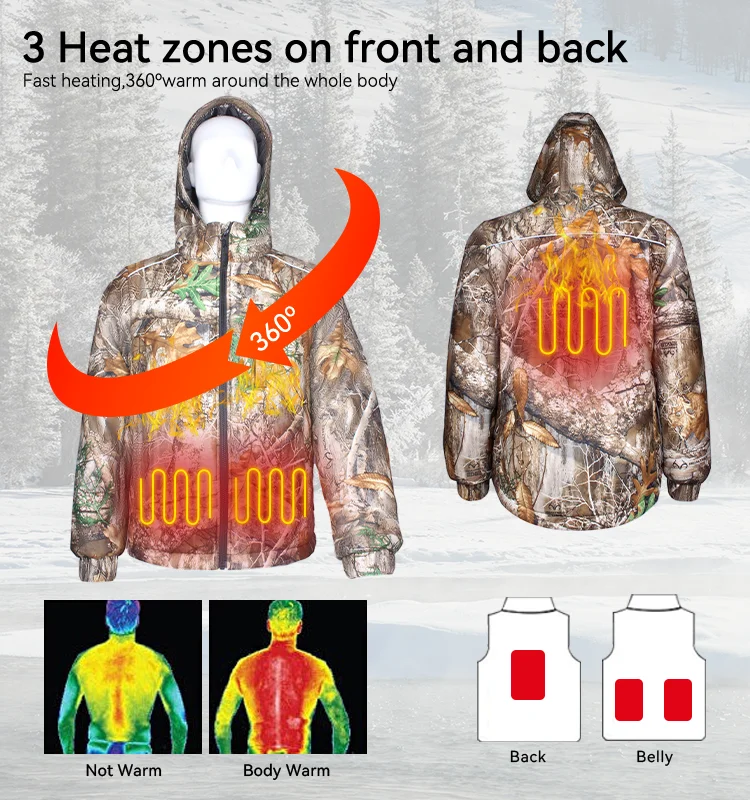
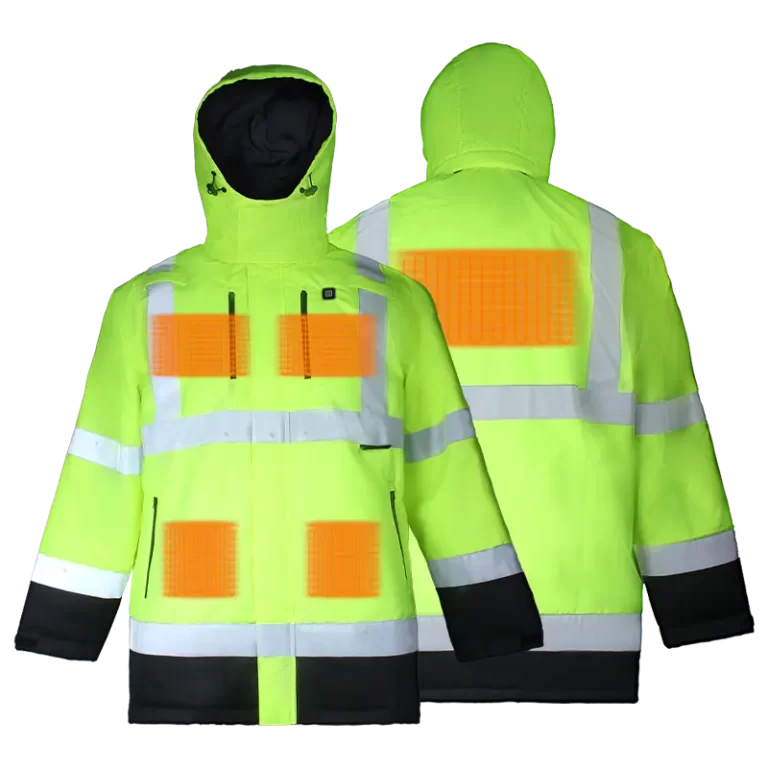
Tier 1 is the typical “first workwear hoodie” SKU for buyers entering the category. Tier 2 adds a reinforced shoulder + elbow layer and a hand-pocket heating zone for utility workers. Tier 3 adds a third lumbar heating zone, an ANSI/ISEA 107-2020 hi-vis accent, and the larger 7,200mAh battery that an 8-hour shift worker actually needs. Most distributors we work with put Tier 2 and Tier 3 in their main catalog; Tier 1 is the SKU they use to win small-account first-time orders.
Workwear Pricing Soft Plant: Two US construction supply distributors approached us in Q1 2026 asking for $30 landed cost on a Tier 2 spec. Both wanted full-package supply with private-label packaging and a 500-unit first PO. We declined at $30 and pointed them to Tier 1 at 1,000 units ($44) or Tier 2 at 2,500 units ($48). One accepted the Tier 1 path and grew volume to 4,000 by Q2; the other accepted Tier 2 and grew to 1,500 by Q2. Both maintained margin and grew account count.
The Seven-Layer Workwear Hoodie Specification Stack
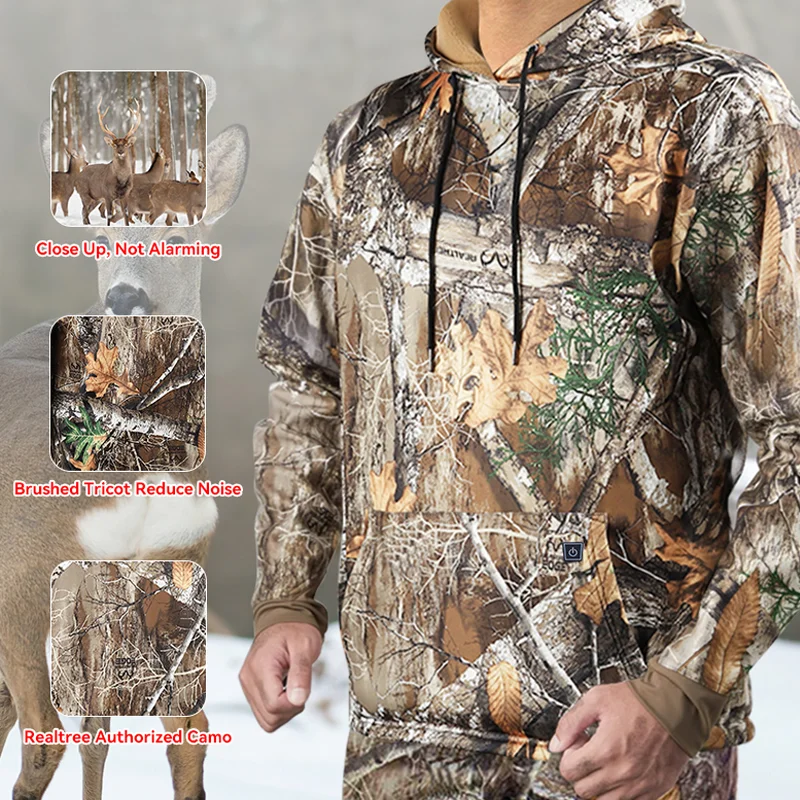
A workwear-grade heated hoodie is not a consumer hoodie with a bigger battery. The seven-layer spec framework below reflects what differentiates a SKU that survives an 8-hour utility shift at 14°F from one that fails on day 12 with a peeling heating element. If a candidate factory cannot hit at least six of the seven layers, they are not a workwear-grade manufacturer; they are a fashion-grade manufacturer trying to stretch upward.
Seven-Layer Workwear Hoodie Spec Stack
| Layer | Element | 2026 Workwear Spec | Reject If… |
|---|---|---|---|
| 1 | Outer Fabric | 380–450 GSM double-knit fleece, anti-pill grade 4+ | < 320 GSM or single-knit fleece |
| 2 | Reinforcement | Cordura shoulder + elbow patches | No reinforcement layer |
| 3 | Hi-Vis Accent | ANSI/ISEA 107-2020 compliant striping (Tier 3 only) | Decorative (non-rated) striping only |
| 4 | Heating Element | Carbon-fiber or graphene composite, 36–52″ coverage | Pad < 28" or wire coil |
| 5 | Battery | 7.4V Li-Poly, 5,000–7,200mAh, sealed BMS, IP54-rated case | No BMS or non-IP-rated case |
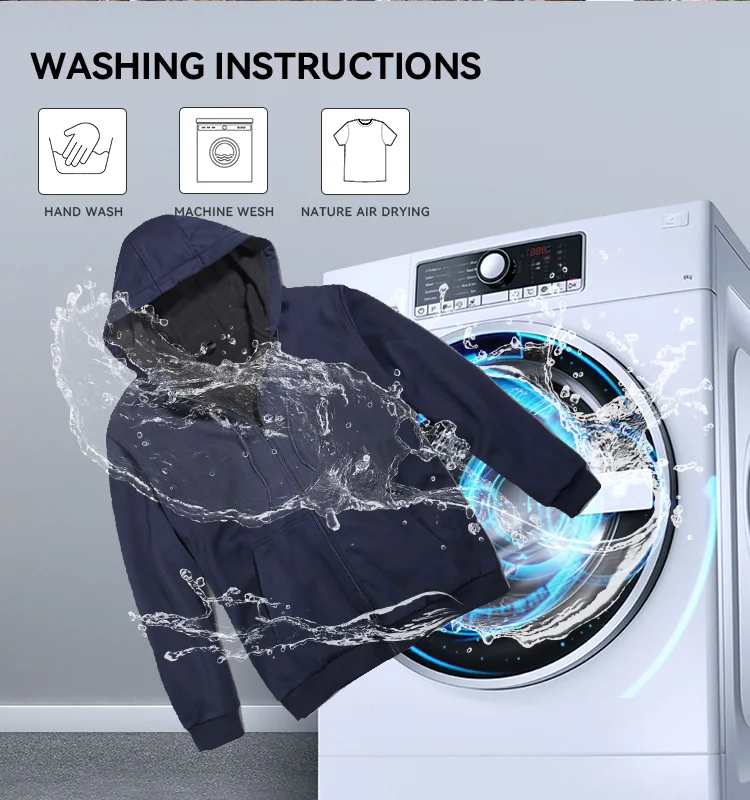
| 6 | Wash Cycles | 50+ machine wash cycles at 40°C, element functional | Hand-wash only or < 30 cycle rating |
| 7 | YKK + Snaps | YKK main + YKK Aquaguard battery pocket + snap cuff closure | SBS / no-name or elastic cuffs only |
The two layers most often missed at RFQ stage are layer 3 (ANSI-107 hi-vis) and layer 6 (50+ wash cycles). Buyers forget to require ANSI-107 and then have to recall or re-spec the SKU when they realize their construction-account clients require rated hi-vis. Buyers forget the 50-cycle wash requirement and end up with a hoodie whose heating element dies after 30 industrial laundries, which is roughly 5 weeks at a major utility account.
2026 Workwear Safety and Compliance Pack
Unlike fashion-grade heated hoodies, workwear SKUs are subject to the same compliance regimes as the personal-protective-equipment (PPE) category. For an industrial buyer, the following eight documents must accompany every shipment. Most large industrial accounts will refuse to put a heated hoodie on their workers without them.
Workwear Compliance Documents: 2026 Standard Pack
| Document | Issuing Authority | Validity Period | Required For |
|---|---|---|---|
| UN 38.3 Test Report | Third-party lab (BV / SGS / TUV) | 12 months | All lithium cells, all destinations |
| UL 2054 or IEC 62133 | UL / TUV Rheinland | 3 years | US (UL) or EU (IEC) distribution |
| ANSI/ISEA 107-2020 (Tier 3 hi-vis) | ANSI-accredited lab | 5 years | Construction + utility workwear |
| EN ISO 20471 (EU hi-vis) | EU notified body | 5 years | EU workwear accounts |
| CSA Z96 (Canada hi-vis) | CSA Group | 5 years | Canadian oil-and-gas accounts |
| ASTM F2675 (clothing with electronics) | ASTM International | 5 years | US workwear (general) |
| CE PPE Regulation (EU) 2016/425 | EU notified body | 5 years | EU workwear (general) |
| Care Label Compliance | Factory | Per SKU | FTC 16 CFR 423 (US) / EU 1007/2011 |
Two of these (ANSI/ISEA 107-2020 and EN ISO 20471) are region-specific. A workwear hoodie sold in the US construction market typically uses ANSI striping; the same SKU sold to an EU utility must use ISO 20471 striping. Some industrial buyers carry both ratings under separate SKUs to cover both markets; some pick a single market and accept the regulatory friction of the other.
The 2026 BMS Thermal Cutoff Standard for Workwear
Workwear-grade battery packs require a stricter thermal cutoff than consumer-grade packs. The 2026 standard across all major industrial buyers is 55°C thermal cutoff at the cell level with a secondary 65°C hardware fuse on the BMS output. This is roughly 5°C stricter than the consumer-grade standard, and it reflects the higher duty cycle (8 hours of intermittent heating) that an industrial worker’s hoodie sees in a single shift.
Five BMS checks every workwear buyer should require before any pack ships:
- UN 38.3 Lot Traceability — every cell lot has a unique serial number and a per-lot UN 38.3 report. Cell manufacturer must be a tier-1 supplier (ATL, BAK, EVE, LG, Samsung SDI, Murata).
- 5,000mAh Minimum Capacity at 7.4V — anything below 5,000mAh fails the 5-hour high-heat runtime test required by most industrial accounts. Workwear Tier 3 uses 7,200mAh cells.
- 55°C Primary Thermal Cutoff — verified by per-pack test, not lot-level extrapolation. Each pack serial is logged with cutoff activation temperature.
- IP54-Rated Battery Case — required for any outdoor/construction/utility use. IP54 = dust-protected + splashing water. IP67 is preferred for utility workers but raises pack cost 12–18%.
- Cycle Life ≥ 500 Charges to 80% Capacity — verified by third-party lab report. Workwear users hit 500 cycles in roughly 14 months, so anything below that turns into a warranty spiral.
The single biggest cause of heated workwear RMA is a consumer-grade battery pack being installed in a workwear SKU. If your vendor is offering “compatible” or “industrial-grade” labels but is shipping a consumer-tier pack, the entire warranty math breaks down at month 8.
BMS Soft Plant: A US utility buyer placed a 1,500-unit PO for Tier 3 hoodies in Q4 2025 with a vendor that was actually shipping Tier 1 BMS packs. By month 6, BMS failures ran at 4.2% (vs the 0.6% target). The buyer had to recall the inventory, replace all BMS packs at vendor expense, and shift the next PO to a different factory. The cost of that recall was 8× the savings from the initial lowball quote. Workwear battery specs are not optional.
Workwear-Specific MOQ Tiers: How They Differ From Fashion MOQ
Workwear MOQs are typically 30–50% lower than fashion MOQs at the same factory, because industrial buyers are placing multi-account blanket POs rather than single-SKU retail programs. The factory’s production planning is also different: workwear SKUs run 12+ months a year at steady volume, while fashion SKUs run 6–9 months at variable volume. Steady volume is easier on the cutting table, so factories reward it.
Workwear Hoodie MOQ Tiers in 2026
| Vendor Type | Min Order / SKU | Min Order / Colorway | Typical Lead Time | Sample Fee Refundable? |
|---|---|---|---|---|
| Workwear-grade OEM (Vietnam/China) | 50 units | 100 units | 65–85 days | Yes (PO ≥ $25k) |
| Workwear-grade ODM (Vietnam) | 100 units | 200 units | 55–75 days | Yes (PO ≥ $35k) |
| Multi-category factory (fashion + workwear) | 200 units | 400 units | 60–80 days | Often partial |
| Trading company / sourcing agent | 50 units | 100 units | 70–90 days | Rarely |
The “Sample Fee Refundable?” column is the indicator. A workwear-grade factory will almost always refund sample fees against a subsequent workwear PO, because they are amortizing sample cost into a multi-year program. A trading company will rarely refund, because they subcontract the sample themselves and pay for it out of pocket. Use the refundable-sample clause as a vendor-vetting gate.
2026 Workwear Vendor-Vetting Checklist: 12 Buyer Questions
Before any deposit is wired on a workwear program, the following 12 questions should all have written answers. Treat a “yes” as baseline (the vendor can do it) and a “yes, with documentation” as best practice (the vendor has done it for an industrial account and can show evidence).
- What is your cut-and-sew capacity per month for workwear-grade heated hoodies?
- Do you produce your heating elements in-house or outsource?
- Can you provide UN 38.3, UL 2054, and ANSI/ISEA 107-2020 test reports dated within 18 months?
- What is your 2025 and Q1–Q2 2026 on-time delivery rate, audited?
- What is your AQL inspection standard, and which third-party inspectors do you accept?
- What is your workwear warranty policy and the industrial-accounts RMA process?
- What is your sample-fee structure, and which fees are refundable?
- What is your MOQ per SKU and per colorway, and which months are constrained?
- What is your PPS lead time, and can you commit to a 25-day PPS turnaround?
- Do you have 3 B2B reference industrial accounts we can contact?
- What is your labeling compliance workflow for US/EU/CA destination packaging?
- What is your policy if the buyer reports a defect rate above 2% on industrial accounts?
Six or fewer satisfactory answers is a no. Seven to ten means follow-up. Eleven or twelve means you have an industrial-grade partner.
The 4-Stage Workwear QA Gate
A factory with documented QA at four stages catches 92% of all workwear defects before shipment; a factory with QA at one or two stages catches 48–61%. The four stages are the same as for fashion SKUs, but the acceptance criteria are stricter because the duty cycle is harsher.
4-Stage Workwear Heated Hoodie QA Gate
| Stage | When | What Is Inspected | Acceptance Criteria |
|---|---|---|---|
| 1 — DUPRO (in-line) | 30% production complete | Random 12 pcs: GSM, reinforcement, heating element, wire harness, controller, trim | ≤ 1 minor defect, 0 major defects |
| 2 — Functionality test (heat) | 100% production | Heat low/mid/high at 5 min with thermometer probe | Low ≥ 100°F, Mid ≥ 120°F, High ≥ 145°F (workwear runs hotter) |
| 3 — Battery BMS verify | Per pack | Short-circuit, thermal cutoff at 55°C, capacity retention, IP54 case integrity | UN 38.3 lot pass; per-pack serial trace |
| 4 — Pre-shipment AQL 2.5 | Pre-shipment | Random carton sample (ANSI/ASQ Z1.4 General II) | AQL 2.5 pass, drop-test pass on 1 in 10 cartons |
The stage most often missed at workwear is Stage 3 (battery BMS verify). Some factories default to the consumer-grade cutoff (60°C) instead of the workwear-grade (55°C). The 5°C difference is invisible on the spec sheet — both look like “thermal protection” — but it is the difference between a safe pack and a pack that fails at 60°C in a hot truck cab.
QA Soft Plant: A US utility buyer audited 16 candidate factories in Q1 2026 for a 2,500-unit Tier 3 program. Only 7 of 16 hit the 55°C thermal cutoff standard. Of the 7, only 4 had documented AQL 2.5 records for the previous 6 months. Of the 4, only 2 carried B2B industrial references in the US or EU. The buyer ended up placing the PO with one of those 2, and the program shipped at 1.1% defect rate in Q3. QA is a funnel — the more gates you set, the smaller (and more capable) the vendor pool becomes.
The 2026 Workwear Warranty Workflow That Keeps Service Tickets Under 1.2%
Industrial accounts generate service tickets at roughly 3× the rate of consumer buyers, because the duty cycle is harsher and because industrial buyers expect vendor support (rather than just replacements). A well-designed warranty workflow drops service-ticket volume from a typical 2.8–3.5% to roughly 1.1–1.4% — a meaningful margin difference on a 5,000-unit-per-year program.
2026 Workwear Warranty Workflow: 4-Step Model
| Step | Action | Owner | Turn-Around Target |
|---|---|---|---|
| 1 — RMA Intake | Buyer submits RMA with photo + serial number | Buyer (industrial account) | Same business day |
| 2 — Diagnostic | Factory tech reviews RMA, classifies failure mode | Factory + Buyer QC | 3 business days |
| 3 — Replacement | Factory ships replacement hoodie + battery pack | Factory | 7 business days from RMA approval |
| 4 — Root-Cause Review | Quarterly review of RMA patterns; factory reports top 3 failure modes | Factory + Buyer | Quarterly |
Step 4 is the step most programs skip, and it is the step that determines whether the next PO cycle ships with the same defect rate or a 0.4–0.6% lower one. If the factory refuses to commit to quarterly root-cause review, treat that as a red flag — it usually means the factory is batching all RMAs into a single replace-without-diagnose workflow, which fails to drive systematic improvements.
Final Recommendation: Launching a 2026 Workwear Heated Hoodie Program
For B2B buyers planning a 2026–2027 workwear hoodie program, the most resilient approach combines four moves. Choose one workwear-grade heated hoodie manufacturer for the core program (Tier 2 or Tier 3). Choose a second workwear-grade factory as backup so you have a comparison during renewal negotiations. Run the seven-layer spec stack as a written contract appendix with every shipment. And demand the four-stage QA gate with per-pack BMS documentation before any carton ships.
If you are evaluating a new workwear factory for 2026, request the UN 38.3 battery test report, the ANSI/ISEA 107-2020 report (if Tier 3), the AQL inspection record from the previous three shipments, and three B2B industrial references. Place a 50-unit test order, run it through your in-house QA + a 50-cycle wash test, and only scale after the test order clears every spec layer. The factory that complains about that process is the factory that will fail at the QC stage; the factory that welcomes it is the factory that will still be here in 2030.
Quick Reference Glossary: Heated Hoodie for Work 2026
Any B2B heated hoodie for work program touches the same 12 vocabulary items. Distributors who internalize this glossary before their first RFQ save 3–5 weeks of vendor back-and-forth. Print this section and keep it open while reading vendor specs.
| Term | Definition | 2026 Standard |
|---|---|---|
| Heated Hoodie for Work | Workwear-grade heated pullover with reinforced shoulders + IP54 battery pocket | 50 units MOQ, 65-85 day lead time |
| Workwear Heated Hoodie | Industrial duty-cycle hoodie, 8-hour shift, 50+ wash cycles | $50-$86/unit at 500-1,000 units |
| Heated Hoodie Manufacturer | Vertical factory covering heating element + battery + garment assembly for workwear | Minimum 5,000 sqm, 6+ production lines |
| Battery Heated Hoodie Workwear | Hoodie with 7.4V removable battery, dual heating zones, Cordura reinforcement | Tier 2 spec, $54-$66 at 500+ units |
| Heated Clothing Wholesale | Full-package supply (garment + battery + charger + retail box) to workwear distributors | $34-$68/unit at 2,500+ units |
| Heated Hoodie OEM | Original Equipment Manufacturer builds the workwear hoodie to your spec | 100 units MOQ, 60-85 day lead time |
| 7.4V Li-Poly Battery | Lithium-Polymer 7,200mAh workwear-grade pack with sealed BMS | 55°C thermal cutoff (workwear) |
| Carbon-Fiber Heating Pad | 36-52″ coverage for workwear vests, hoodies, and jackets | Premium spec, multi-zone distribution |
| ANSI/ISEA 107-2020 | US hi-vis safety standard – required for construction and utility accounts | 5-year validity, ANSI-accredited lab report |
| EN ISO 20471 | EU hi-vis safety standard – required for EU utility workwear accounts | 5-year validity, EU notified body |
| YKK Aquaguard Battery Pocket | Waterproof YKK zipper pocket designed for 7.4V battery pack | Standard at all temperature ranges |
| AQL 2.5 | Acceptance Quality Limit – ANSI/ASQ Z1.4 sampling standard | Required for US/EU retail-bound shipments |
| PPS Sample | Pre-Production Sample from bulk fabric + bulk trim – signs off production | Day 29-42 milestone in 65-day timeline |
| Heated Hoodie Work 2026 | The category-year label for 2026 workwear-grade heated hoodies | Standard wholesale framing |
| Heated Hoodie Utility | Workwear sub-category targeting utility line workers, grid crews, and field techs | Tier 3 with ANSI-107 striping + 7,200mAh battery |
Vendors who use these terms in their RFQ responses – and who can put a working definition of each in their quote – are vendors worth a follow-up meeting. For battery heated hoodie workwear orders specifically, demand that the vendor list the heating-pad coverage in inches and the cell manufacturer by name in the spec sheet; if either is missing, push back before RFQ acceptance.
The broader heated hoodie for work conversation in 2026 centers on industrial buyers who treat their account as a multi-year program rather than a one-off PO. A heated hoodie for work program that ships 2,500 units in Q3 2026 should be planned around a 12-month blanket PO so the factory can reserve capacity and hit lead times under 80 days. First-time buyers of heated hoodie for work SKUs benefit from a 50-unit test run with full wash-cycle testing before committing to the 1,000-unit program; that test run validates the BMS thermal cutoff, the Cordura reinforcement, and the hi-vis striping durability. When you ask a factory to walk through their heated hoodie for work workflow (element cut + sew, BMS pairing, hi-vis stripe application, per-pack BMS test), the strength of each answer predicts the strength of the program. The factory that demos all four steps – and that documents each step with photos – is the factory that scales to 5,000 units per year without quality drift. Treat the heated hoodie for work category as a battery-vest line extension rather than a fashion line: the duty cycle, the warranty math, and the compliance regime are all closer to PPE than to outdoor apparel.
FAQ: Heated Hoodie for Work in 2026
Q1. What is the typical MOQ for a workwear heated hoodie in 2026?
A. Most workwear-grade factories require 50–200 units per SKU with a 55–85 day lead time. Premium workwear partners go as low as 50 units per colorway for buyers with 12-month commitment of 1,000+ units.
Q2. How much does a workwear heated hoodie cost per unit?
A. Landed cost for a 500–1,000 unit workwear hoodie runs $50–$86 depending on spec tier. Volume above 2,500 units typically drops the per-unit cost to $34–$68 depending on tier.
Q3. What is the lead time from PO to warehouse?
A. A workwear-grade hoodie takes 65–100 days from PO to warehouse. Lead times above 100 days usually indicate a vendor with capacity issues or workwear/fashion split-run constraints.
Q4. What battery specs are required for a workwear heated hoodie?
A. Minimum 5,000mAh at 7.4V, sealed BMS with 55°C thermal cutoff, IP54-rated case, UN 38.3 and UL 2054 (or IEC 62133) certification. Premium workwear uses 7,200mAh cells.
Q5. What workwear safety standards should a hoodie meet?
A. ANSI/ISEA 107-2020 (US), EN ISO 20471 (EU), CSA Z96 (Canada), ASTM F2675 (general US), CE PPE Regulation (EU) 2016/425 (EU general). The rating you need depends on destination market and whether hi-vis is in the spec.
Q6. What is the difference between workwear and consumer grade BMS?
A. Workwear-grade BMS uses a 55°C thermal cutoff and IP54 case; consumer-grade uses 60°C cutoff and often no IP rating. Workwear packs also require per-pack serial-number traceability for industrial-accounts warranty support.
Q7. How many wash cycles must a workwear hoodie survive?
A. Minimum 50+ machine wash cycles at 40°C with the heating element fully functional. Industrial accounts typically run a 5-cycle-per-week rotation; 50 cycles = roughly 10 weeks of normal use.
Q8. Can I private-label a workwear hoodie with my own branding?
A. Yes, at 100+ units per SKU with $280–$650 per sample (refundable against PO ≥ $30,000). Below 100 units, you can use a stock hoodie with custom hangtag/barcode only.
Q9. What is the typical defect rate on a 1,000-unit workwear order?
A. A reputable workwear-grade factory with documented AQL 2.5 inspection delivers 1.0–1.8% defect rate. Anything above 2% on a consistent basis is a vendor-vetting failure, not a normal outcome.
Q10. How do I handle industrial-accounts warranty and RMA?
A. Negotiate a 2% spare-unit allocation in your PO contract. Set up a 4-step warranty workflow (RMA intake → diagnostic → replacement → root-cause review) with the factory. Run quarterly root-cause reviews to drive defect rate down over time.
Q11. Is Vietnam or China better for workwear heated hoodies in 2026?
A. Vietnam has lower MOQ floors and shorter lead times for small batches but costs 8–14% more per unit. China is more cost-effective above 1,000-unit volume. Both countries now produce comparable BMS quality. Vietnam has a tariff advantage for US import (3% vs 14% China).
Q12. What is the smallest order for a fully custom workwear hoodie in 2026?
A. The smallest fully custom order (custom color + trim + label + packaging + reinforcement + ANSI striping) is 50 units per colorway in 2026, with 90–120 day lead time. Stock-hoodie + custom-box programs can be as low as 25 units with 30-day lead time.
This guide is maintained by gearplant.com’s B2B workwear team based on Q1–Q2 2026 buyer engagements and factory-audit data. Last updated July 9, 2026.