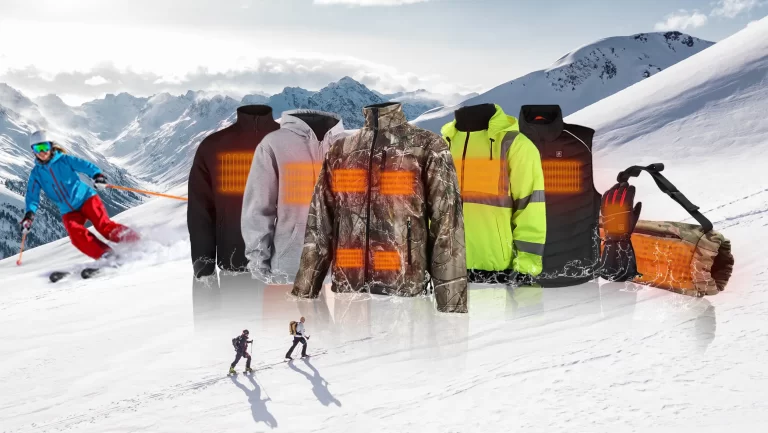
Wholesale Heated Apparel ESPR Self-Regulation 2026: the Buyer Acceptance Binder for the Article 21 Voluntary Route
Every heated jacket on a European purchase order today sits under a general framework, not a product rule. Regulation (EU) 2024/1781, the Ecodesign for Sustainable Products Regulation (ESPR), is in force, but no textile delegated act and no Article 21 listing implementing act has been adopted. The binding EU law for a heated garment today is the ESPR framework plus Regulation (EU) 2023/1542, REACH Regulation (EC) No 1907/2006 and POPs Regulation (EU) 2019/1021. Article 21 is a voluntary industry route, not a legal duty on a buyer.
What Article 21 changes for a heated apparel buyer, and what it does not
article 21 self-regulation measures lets economic operators draft ecodesign requirements themselves and ask the Commission to list them. Article 2(38) defines a self-regulation measure as a voluntary agreement or code of conduct, concluded by economic operators on their own initiative, which they are responsible for enforcing. Article 21(1) opens the route for products not within the scope of an Article 4 delegated act or not included in the working plan, and no textile delegated act exists yet.
| Instrument | Status | Buyer consequence |
|---|---|---|
| ESPR Regulation (EU) 2024/1781 | Framework in force | No textile ecodesign requirement in force |
| Article 4 delegated act for textiles | Not adopted | Nothing to comply with yet |
| Article 21(3) implementing act | Not adopted | No listed measure exists |
| Industry-submitted Article 21 measure | Possible, not listed | No legal effect until listed |
| Batteries Regulation (EU) 2023/1542 | Separate law | Binding battery documentation |
| REACH Regulation (EC) No 1907/2006 | Separate law | Binding material declarations |
| POPs Regulation (EU) 2019/1021 | Separate law | Binding material testing |
| Article 26 unsold-goods information | Due 19 July 2027 | Information duty, not a ban |
Article 21(6) sets the boundary: once a measure no longer meets the Article 21(3) criteria it is deleted from the list, and the Commission may then set requirements by delegated act. Listing buys time, not immunity.
The Article 21(2) binder: six mandatory items to demand
wholesale heated apparel espr self-regulation manufacturer capability is audited through the six content items in Article 21(2). A supplier that cannot produce all six has written a code of conduct, not a self-regulation measure. Allow roughly $0.73 per unit for the evidence pull.
| Item | Mandatory content | Evidence to demand | Fail condition |
|---|---|---|---|
| (a) | List of signatory operators | Entity names, units placed on market | Brand names only |
| (b) | Ecodesign requirements | Full requirement text | Summary deck only |
| (c) | Monitoring plan, inspector duties, Annex VI point 6 | Named inspector, selection procedure | No inspector named |
| (d) | Rules on reporting, testing, inspections | Sampling plan, test methods | Self-certification only |
| (e) | Removal after three months non-compliance | Signed undertaking to enforce | No removal consequence |
| (f) | Note on faster or cheaper improvement | The note and its analysis | Unsupported assertion |
Article 21(2) also requires signatories to keep that information up to date on a publicly accessible website and to notify the Commission without delay of any change. Ask for the live URL, not a PDF.
The signatory list and the 80% market-share test
Article 21(3) sets five conditions the Commission verifies before anything is listed: at least two economic operators submitted the measure; the signatories together hold at least 80% of units placed on the market for the covered products; the measure delivers the objectives faster or at lower cost than a delegated act; it complies with Annex VI; and it is in line with Union law and trade commitments. Volume evidence is the expensive part: on a $3,650 per 5,000-unit order, attestations cost more audit time than paperwork.
| Criterion | Requirement | Evidence to demand | Verification method |
|---|---|---|---|
| 21(3)(a) | At least two economic operators | Two or more named signatories | Registry check per signatory |
| 21(3)(b) | At least 80% market share by volume | Volume attestation per signatory | Reconcile against unit data |
| 21(3)(c) | Faster or cheaper than a delegated act | The Article 21(2)(f) note | Read baseline and cost model |
| 21(3)(d) | Complies with Annex VI | Completed scorecard | Run the seven-point test |
| 21(3)(e) | Aligned with Union law and trade commitments | Consistency assessment | Legal review |
Until an implementing act lists a measure, no signatory list makes a supplier compliant with anything. Treat an 80% claim as unverified marketing until an Official Journal reference exists.
Annex VI self-regulation criteria: the seven-point scorecard
wholesale heated apparel espr self-regulation oem questions land on this list every quarter. Annex VI sets a non-exhaustive list of criteria, and suppliers score well on the points they chose while ignoring the costly ones.
| Point | Criterion | Buyer question | Red flag |
|---|---|---|---|
| 1 | Openness of participation | Public announcement first; SMEs and third-country operators able to join? | Closed pilot |
| 2 | Sustainability and added value | Environment, consumers, health, quality of life integrated? | One environmental metric |
| 3 | Representativeness | Meets Article 21(3)(b); Article 101 TFEU respected? | No volume data |
| 4 | Quantified and staged objectives | Baseline, quantified and interim targets | Open targets |
| 5 | Involvement of civil society | Publicised online; Member States, industry, NGOs invited to comment | No published comments |
| 6 | Monitoring and reporting | Independent inspector, conflict rules, one-year report | Inspector employed by lead signatory |
| 7 | Cost-effectiveness | Monitoring cost proportionate to objectives | Open-ended monitoring cost |
Annex VI point 6 also requires market surveillance results identifying non-compliance to be taken into account by the inspector, with corrective action.
Article 18 working plan prioritisation: where a heated garment sits in the queue
article 18 working plan prioritisation is where timing risk on a heated apparel program gets priced. Article 18(3) requires a publicly available working plan of product groups to be prioritised, with timelines, covering at least three years and updated regularly. Article 18(5) fixes the first working plan, adopted by 19 April 2025, naming textiles among the prioritised groups.
| First working plan group | Relevance to a heated apparel buyer |
|---|---|
| (c) Textiles, in particular garments and footwear | Direct: heated jackets, vests, gloves, footwear |
| (i) Chemicals | Battery chemistry and shell treatments |
| (k) ICT products and other electronics | Control board and wiring |
| (a) to (b), (d) to (h), (j) | No direct effect on apparel |
Article 18(1) sets the prioritisation criteria, including the absence or insufficiency of Union law or the failure of self-regulation measures to address the objective. A textile measure is weighed against a delegated act, not a substitute for one.
Ecodesign Forum Member States Expert Group: where the early signal shows up
ecodesign forum member states expert group is where a buyer monitors intent before it becomes a delegated act. Article 19 establishes the Ecodesign Forum as an expert group of Member State experts and interested parties, and Article 20 establishes the Member States Expert Group as its subgroup.
| Body | Composition | Functions under ESPR |
|---|---|---|
| Ecodesign Forum (Article 19) | Member State experts plus industry, SMEs, traders, retailers, importers, consumer and environmental organisations, researchers | Requirements, working plans, market surveillance, self-regulation assessment, Annex VII destruction prohibition |
| Member States Expert Group (Article 20) | Experts designated by Member States, subgroup of the Forum | Requirements, self-regulation assessment, best practice, Article 26 priorities |
| Commission | Assessing and listing | Implementing act under Article 21(3), advisory procedure under Article 73(2) |
Neither body creates obligations for a heated garment. Both are signal sources.
The $9,700 one-time buyer acceptance setup
wholesale heated apparel espr self-regulation wholesale acceptance is a standing internal process, not a per-shipment task. The $9,700 one-time buyer acceptance setup funds the documentation and training that make supplier answers checkable.
| Workstream | One-time cost | Output |
|---|---|---|
| Supplier questionnaire and Article 21(2) evidence intake | $2,340 | Standardised dossier per supplier |
| Signatory list and 80% market-share verification | $1,810 | Verified or unverified status |
| Technical file library for battery, REACH and POPs data | $1,470 | Indexed file set |
| Inspector and monitoring-plan review | $1,620 | Written opinion per measure |
| Delegated-act readiness calendar and playbook | $980 | 60-day calendar, section 11 |
| Staff training on ESPR and Article 21 acceptance rules | $1,480 | Trained sourcing and QC |
| Total | $9,700 | Acceptance binder in use |
Keep the register live. A supplier file marked “voluntary measure, no delegated act applies” must be revisited at every working plan update.
When a supplier says ESPR compliant and nothing has been adopted
The claim arrives constantly because it is unfalsifiable without the implementing act. Handle it with a table.
| Supplier claim | What the regulation actually says | Buyer action |
|---|---|---|
| Our heated jacket is ESPR compliant | No textile delegated act and no Article 21 implementing act has been adopted, so no garment requirement is in force | Request evidence; record as unverified marketing claim |
| We are covered by an Article 21 measure | A measure becomes listed only through an implementing act under Article 21(3) | Ask for the Official Journal reference |
| Our measure covers 80% of the market | Article 21(3)(b) requires 80% of units placed on the market by the signatories, verified by the Commission | Request a volume attestation; verify or reject |
| Nothing applies to apparel | True for ecodesign; battery, REACH, POPs and Article 26 still apply | Confirm battery and chemical documentation |
| A delegated act is coming | The application date under Article 4(4) is not earlier than 18 months after entry into force | Plan to the published date |
Write one factual line into the supplier scorecard: no ecodesign requirement for textiles is in force, and any Article 21 claim is voluntary and unverified until the implementing act is published.
Article 21(6) deletion followed by a delegated act: the re-sourcing trigger
Article 21(6) sets the sequence. Where the Commission considers that a listed measure no longer fulfils the criteria, it deletes it from the list, and it then becomes possible to set ecodesign requirements for the product groups previously addressed.
| Step | Legal reference | Effect on a wholesale buyer |
|---|---|---|
| Measure listed | Article 21(3), second subparagraph | Validated route; convert requirements into contract obligations |
| Progress and compliance reporting | Article 21(5) | Request the latest inspector compliance report |
| Revised version requested | Article 21(4) | Re-run the Article 21(2) binder |
| Deadline missed | Article 21(4), three months from request | Commission may delete the measure |
| Deletion | Article 21(6), implementing act, advisory procedure under Article 73(2) | Voluntary cover ends; supplier falls back on general ESPR |
| Delegated act for the same products | Article 21(6), second subparagraph | Requirements may be set; Article 5(8) still allows overlap |
Article 5(8) is the overlap rule to remember: an ecodesign requirement may cover products within the scope of a listed measure where that measure does not address the product aspects concerned. Voluntary cover is never a safe harbour for the aspects it skipped.
Article 4 and Article 8: what a textile delegated act will contain
Article 8 lists at least twelve elements every delegated act must specify. Article 4(4) sets the application date at not earlier than 18 months from entry into force, and Article 4(5) fixes the conformity assessment route.
| Article 8 element | What it means for a heated garment |
|---|---|
| (a) Scope and commodity codes | Map act scope against the SKU bill of materials |
| (b) Ecodesign requirements | Identify which product features must change |
| (d) Test, measurement or calculation standards | Map to the lab test plan before sampling |
| (g) Format and order of compliance information | Fix the technical file template |
| (h) Conformity assessment module | Module A from Annex IV, or modules B to H1 from Annex II to Decision No 768/2008/EC, adapted under Article 43 |
| (i) Manufacturer information requirements | Extend technical file scope |
| (k) Transitional period duration | Plan clearance of pre-cut-off stock |
Article 26, unsold goods and the 60-day inbound calendar
Article 26 requires the Commission to publish, by 19 July 2027 and every 36 months thereafter, consolidated information on the destruction of unsold consumer products and its comparative environmental impacts. It is an information duty at this stage, not a prohibition on destroying unsold heated garments, and it feeds the Article 18(3) prioritisation of a possible ban.
| Day | Action | Owner |
|---|---|---|
| D-60 | Freeze the SKU list against the delegated act scope | Sourcing |
| D-50 | Map new requirements to test methods and labs | QC |
| D-40 | Confirm the conformity assessment module and Article 8(h) basis | Compliance |
| D-30 | Update cell and battery documentation under Regulation (EU) 2023/1542 | Technical |
| D-20 | Re-run REACH and POPs declarations for changed shell | QC |
| D-10 | Freeze artwork and labels under Article 8(g) and (i) | Marketing |
| D-0 | Application date of the delegated act | Compliance |
Run the calendar against the published application date, not a press estimate. The 18-month floor under Article 4(4) is the anchor, and the transitional period under Article 8(k) decides how much stock survives.
Continued coverage sits in our heated apparel industry news and in our supply chain updates as each of those moves.
Frequently asked questions
Is a heated jacket already subject to EU ecodesign requirements in 2026?
No. No textile delegated act and no Article 21 listing implementing act has been adopted, so binding law today is the ESPR framework plus Regulation (EU) 2023/1542, REACH Regulation (EC) No 1907/2006 and POPs Regulation (EU).
Is Article 21 a legal duty on a wholesale buyer or an Amazon brand owner?
No. Article 2(38) defines a self-regulation measure as a voluntary agreement or code of conduct concluded by economic operators on their own initiative, and listing under Article 21(3) makes it a recognised industry route, not a requirement on you.
What proof do we demand before accepting a supplier’s Article 21 claim?
All six items in Article 21(2): the signatory list, the ecodesign requirements, the monitoring plan with a named independent inspector, the reporting and testing rules, the removal rule after three months without corrective action, and the note on faster or cheaper improvement.
How is the 80% market-share test verified?
The Commission verifies under Article 21(3)(b) that the signatories together account for at least 80% of units placed on the market for the covered products. Request a volume attestation per signatory and reconcile it against the signatory list.
What happens if a signatory fails to comply?
Article 21(2)(e) requires rules under which a signatory without sufficient corrective action within three months is removed. Under Annex VI point 6 the inspector notifies the other signatories and, under Article 21(5), the Commission.
What happens when a listed measure no longer meets the criteria?
Under Article 21(6) the Commission deletes it from the list by implementing act under the advisory procedure in Article 73(2), and may then set ecodesign requirements for the products it covered in a delegated act.
Can a delegated act still cover products inside a listed self-regulation measure?
Yes. Article 5(8) permits an ecodesign requirement to cover products within the scope of a listed measure where that measure does not address the product aspects covered by the requirement.
Does the Article 18 working plan make a textile delegated act likely?
It makes it possible: textiles are among the groups the Commission was required to prioritise in the first working plan adopted on 19 April 2025, covering at least three years under Article 18(3), and it sets no date.
How much time will we have to comply once a delegated act lands?
The application date cannot be earlier than 18 months from entry into force under Article 4(4), except in duly justified cases. Article 8(k) sets the transitional period for stock placed on the market before the cut-off.
Which conformity assessment module applies to a heated garment?
Article 4(5) requires the delegated act to specify either module A from Annex IV or one of modules B to H1 from Annex II to Decision No 768/2008/EC, adapted for the product and requirements concerned under Article 43.
Does the destruction of unsold garments hit us in 2027?
Not directly: Article 26 requires the Commission to publish, by 19 July 2027 and every 36 months thereafter, consolidated information on the destruction of unsold consumer products, and no prohibition on destroying unsold apparel is in force.
What if a supplier refuses to share the signatory list or monitoring plan?
Record the supplier as unverified and do not accept the claim in the product file.