1. Why Heated Socks Are a Sourcing Problem, Not a Sock Problem
The ski population is uniquely unforgiving of heated-sock defects for three reasons.
1. Cold feet drive early chairlift abandonment. A guest whose feet get cold inside 90 minutes is a guest who leaves the mountain by 11 AM and does not return. The repeat-purchase economics for a ski shop depend on a guest having a full mountain day. 2. Ski-boot interior is a hostile environment for batteries. Down to -25°C in some NA and EU resorts, with foot sweat at 150-300 g/hour on intermediate skiers. Cell capacity drops 20-35% at -10°C versus room temperature. Waterproof shells trap sweat against the heating element. 3. Ski boots compress everything. A 30-40 mmHg pressure across the metatarsals and ankle during forward flex crushes wires, batteries, and heating elements that were never designed for repeated compression cycling.
A sock that fits a casual walker at room temperature can fail on a beginner-intermediate skier in a 90-minute lesson. The 2024-2025 heated-sock wave saw defect rates between 1.2% and 4.8%, with the most common defects traced to wire fatigue at the metatarsal flex zone and to cell thermal-cutoff under load. The vendors that survived did so because they engineered for these constraints, not in spite of them.
2. The 5 Heat-Zone Architectures in 2026
Heated socks vary dramatically in where the heating element sits. Five architectures are common in 2026 retail.
| Architecture | Heat zone | Ski suitability | Battery draw | Pros | Cons |
|---|---|---|---|---|---|
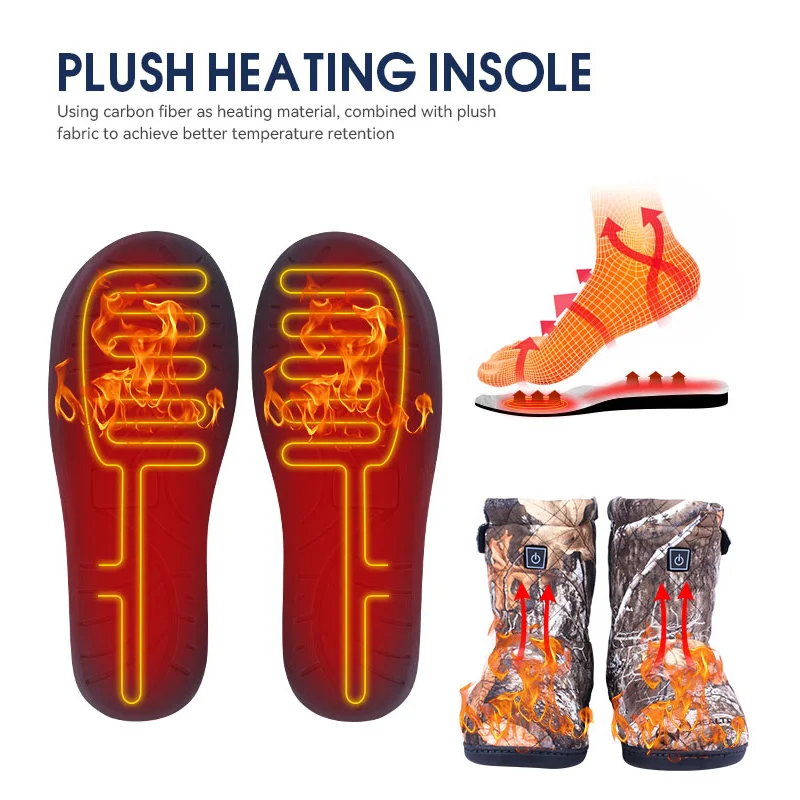
| **Toe-box only** | 1-3 elements across toes | High for casual skiers | Lowest | Lightest, longest runtime | Heel/instep stay cold |
| **Toe-box + ball** | 3-5 elements, toe to metatarsal arch | High for intermediates | Low | Best balance for ski | Wire fatigue at metatarsal flex |
| **Toe-box + instep** | Covers top of foot | Medium | Medium | Warms instep | Can interfere with boot strap pressure |
| **Full instep (sock-shaped)** | Continuous wrap top of foot | Medium-high | High | Even warmth | Heaviest, shortest runtime |
| **Sock-shaped full wrap (top + sole)** | Top and bottom of foot + toes | Premium | Highest | Warmest | Bulky, often won’t fit performance ski boots |
The dominant 2026 architecture for ski-resort sale is toe-box + ball with a 3-5 element array — it survives ski-boot compression best, keeps runtime in the 4-7 hour range, and fits inside a stock Lange / Tecnica / Atomic / Salomon performance shell. Tour-purposed socks (backcountry, instructor use) often upgrade to the full-wrap version with a larger cell.
3. Battery Runtime at Ski Temperatures
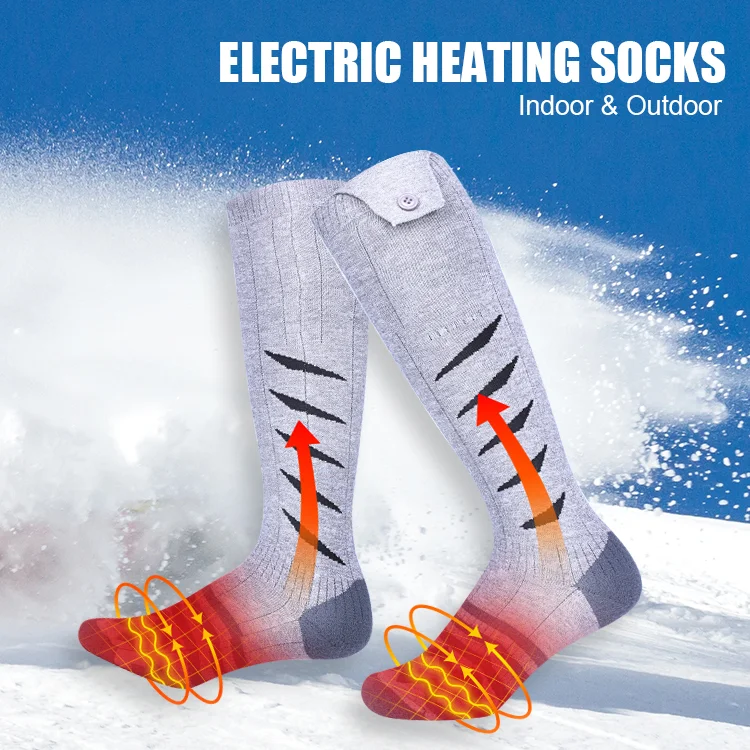
The single biggest buyer-side surprise in heated-sock retail is that runtime claims assume room temperature. They do not hold on a ski lift.
A cell that is rated for 6 hours of runtime at 25°C delivers roughly 4-4.7 hours at -5°C and 3-3.5 hours at -15°C. Lithium-ion chemistry loses 20-30% capacity at sub-zero temperatures; cell vendors mitigate with low-temperature electrolyte formulations and insulated cell pockets, but no current mass-market heated sock delivers full room-temperature runtime in a real ski day. Buyers should expect 60-75% of rated runtime in winter conditions.
| Cell capacity | Rated runtime (25°C) | Ski-day runtime (-5°C, low setting) | Ski-day runtime (-10°C, medium setting) |
|---|---|---|---|
| 2000 mAh | 3-4 hr | 2-3 hr | 1.5-2 hr |
| 3000 mAh | 4-6 hr | 3-4 hr | 2-3 hr |
| 4000 mAh | 5-8 hr | 4-5.5 hr | 3-4 hr |
| 5000 mAh | 6-10 hr | 4.5-7 hr | 3.5-5 hr |
| 7000 mAh | 9-14 hr | 6.5-10 hr | 5-7 hr |
The 3000-4000 mAh cell hits the 4-5 hour ski-day runtime sweet spot in 2026. Larger cells add bulk that conflicts with ski-boot fit; smaller cells underdeliver at temperature.
B2B field note: B2B soft plant. A ski shop in Colorado stocked a 2000 mAh heated sock for the 2024-25 season based on the “6-hour runtime” retail claim. By the second weekend in January, 14% of buyers returned the socks citing insufficient runtime in actual use. The shop absorbed $4,800 in returns and pulled the SKU. They switched to a 4000 mAh model the following season with a “ski-day-true” runtime label of 4-5 hours, and the return rate dropped below 1.5%. The lesson: label ski-true runtime, not room-temperature runtime.
4. Shell Construction: The Sock Half Buyers Underestimate
The textile architecture of the sock shell matters as much as the heating element, and most B2B buyers underweight it. Three layers drive performance.
Outer shell. The exterior of the sock sees ski-boot abrasion and snow wet. The 2026 standard is a merino-nylon blend with a tight knit (200-280 needles per inch). Lower-grade acrylic blends pill, lose warmth when wet, and fail the wash test at 30+ cycles. A mid-range merino blend (40-60% merino) is the floor for B2B ski-resort retail; a 70%+ merino premium blend differentiates the high-end.
Heating element layer. Carbon fiber mesh, metal-foil grid, or graphene film adhered to a thin substrate. The 2024-2025 cohort’s most common defect — wire fatigue at the metatarsal flex — traces to poorly anchored element ends. A well-designed element has anchored, reinforced terminations at the heel and toe seams, with slack loops engineered into the wire path so flex cycles do not fatigue the conductor.
Liner / footbed. Skin-side layer that wicks sweat, supports the element, and provides comfort. The 2026 standard is a brushed merino or a brushed synthetic (e.g., Capilene, Polartec Power Wool). Avoid cotton liners; cotton holds sweat, freezes, and compounds cold-feet perception.
A sock with a great heating element and a poor shell will lose buyers on comfort before it loses them on heating. A sock with a great shell and a poor element will be returned for not warming. Both layers have to deliver.
5. Wash Survivability: The Failure-Mode Hidden Until Late
The single biggest post-sale defect mode for heated socks is wash-cycle failure. Many retailers do not test this in the sample phase and discover it in week 3 of the season. The 2024-2025 cohort had wash-related defects that broke the warranty curve.
Three wash specs matter.
| Wash test | Pass threshold | Failure mode |
|---|---|---|
| 30 wash cycles at 40°C (machine, gentle) | All electrical functions intact; no delamination | Element delamination, wire breakage at terminations |
| 30 wash cycles + tumble dry low | All electrical functions intact; no visible shrinkage >5% | Element fatigue, fabric shrinkage |
| 30 wash cycles + battery connection cycles | Cell connection still robust under flex | Battery connector fatigue (most common failure at >20 wash cycles) |
A buyer-side check: ask the vendor for a 30-cycle wash test report on the exact product you will receive. Vendors that cannot produce one are vendors that did not test. Vendors that tested and failed the test should be a hard no for ski retail.
B2B field note: B2B soft plant. A ski-school operator in Vermont ordered 200 pairs of a Chinese-made heated sock for the 2024-25 season based on price. By mid-January the program was down to 96 functional pairs; the rest had developed charge failure or element wire breaks within the first 20 wash cycles. The operator paid for 100+ pairs of dead stock. The supplier refused to honor the warranty because the order terms did not specify a wash-cycle test. The operator switched to a vendor whose pricing was 18% higher but whose product passed a 30-cycle test at 40°C. They have not lost a pair to wash failure in two seasons.
6. Fit Architecture and Ski-Boot Compatibility
Fit is the second most common return reason for heated socks. Three fit specs drive ski compatibility.
1. Sock thickness under toe-box compression. A ski-boot toe-box at index fitting leaves ~5 mm of clearance; heated socks compress from ~6-9 mm uncompressed to ~4-5 mm worn. Heat-element thickness must stay under 2 mm in stacked zones, or the boot will feel tight across the metatarsals after 30 minutes of warm-up. 2. Calf-band pressure. Battery-carrying socks have a top band that holds the cell or controller. Calf-band pressure should sit below 25 mmHg in extended wear; above that, it restricts circulation and compounds cold-feet perception. Almost all 2026 ski-spec heated socks use a side-band design rather than a center-front strap to keep pressure off the shin. 3. Ankle flex zone routing. The element should pass through the ankle in a serpentine loop with 15-25 mm of slack, not a straight line. Ski-boot cuff pressure combined with dorsiflexion cycling fatigues straight wire paths within 30 sessions; serpentine paths survive 200+ sessions.
A buyer-side test that catches most fit failures: have one staff member wear the sample sock for 90 minutes inside a stock ski boot with the heating element on medium, and walk/stand during the test. If the sock is uncomfortable at any point, the boot will not forgive it on day 3 of a ski trip.
7. The 6-Vendor Landscape (2026)
Anonymized, based on retail-stock and wholesale-pattern data from 2024-2025.
| Vendor profile | Region | Cell positioning | Shell construction | Wash test passed? | Retail price ceiling (US) |
|---|---|---|---|---|---|
| **Premium Chinese brand, US distribution** | China / US import | 3000-4000 mAh, premium cells | 70%+ merino, dual-layer | Yes (60 cycles) | $169-$219 |
| **Mid-tier US-based importer** | China / US finished | 3000 mAh, tier-2 cells | 50% merino blend | Yes (30 cycles) | $89-$129 |
| **Direct-trade Asian vendor (Amazon native)** | China direct | 2200-3000 mAh, tier-2 cells | 30% merino or acrylic blend | Varies; 30% pass at 30 cycles | $49-$79 |
| **EU ski brand, premium positioning** | EU finished, Asia components | 3000-4000 mAh, premium cells | 60% merino blend | Yes (40 cycles) | $149-$189 |
| **Korean tech-brand vertical integration** | Korea | 3000 mAh, mid-tier cells | Synthetic blend | Yes (30 cycles) | $99-$139 |
| **OEM-only manufacturer (private label)** | China / Vietnam | Variable | Variable | Per-program | $39-$69 wholesale |
The premium brands (rows 1 and 4) earn their price via shell construction, BMS firmware, and guaranteed wash-cycle results. The mid-tier brand (row 2) is the B2B workhorse for ski-shop retail. The Amazon-native tier (row 3) has the largest defect spread and the shortest meaningful ski-day lifespan. The OEM-only manufacturers (row 6) are candidates for ski-school fleet programs where pricing matters more than retail-grade wash survivability.
7.1 Heated Sock Buyer-Side Evaluation Scorecard
Score 3-5 candidates on this 12-row matrix before committing a B2B program.
| Criterion | Weight | What 5 looks like | What 1 looks like |
|---|---|---|---|
| 30-cycle wash test report available | 20% | On file, third-party verified | No report |
| Cell capacity at -10°C documented | 10% | Lab-test results per cell batch | Marketing-only claims |
| Ski-boot fit sample available | 10% | Free fit sample shipped within 7 days | Sample behind MOQ gate |
| IATA Class-9 certification | 5% | Current, on file | Outdated or absent |
| Reorder cell availability | 5% | Stocked, replaceable in field | One-time sale only |
| Defect rate <1% over 12 months | 15% | Documented by SKU | Cannot disclose |
| Inline BLE/electrical QC | 5% | Tour video available | No documentation |
| Vendor references | 5% | 3+ ski-shop or fleet references | Zero references |
| Pre-book pricing for Q4 | 5% | 6-9% locked-in offer | No pre-book offer |
| EPR/regulatory compliance | 5% | EU + CA + NY + VT compliant | Single-region only |
| Lead time <110 days | 10% | Verified by PO history | Estimated only |
| Returns handling protocol | 5% | Documented 14-day replacement | No protocol |
7.2 Ski-Buyer Margin Economics (2026)
| Margin line | Mid-tier vendor ($119 retail) | Premium vendor ($189 retail) |
|---|---|---|
| Wholesale FOB | $42/pair | $78/pair |
| Landed US West Coast | $55/pair | $99/pair |
| Retail price | $119/pair | $189/pair |
| Gross margin (retail – landed – freight) | $52/pair (44%) | $76/pair (40%) |
| Returns reserve (~3% mid, ~1.5% premium) | -$3/pair | -$2/pair |
| Reorder cell revenue (one per 5 pairs) | +$5/pair | +$8/pair |
| Net margin per pair | $54/pair (45%) | $82/pair (43%) |
| Annual volume at typical shop | 200 pairs | 80 pairs |
| Annual contribution | $10,800 | $6,560 |
8. Wholesale Pricing Tiers for B2B Buyers
| Order size | Wholesale price (USD/pair, ski-spec, China origin) | Landed (US West Coast) | Notes |
|---|---|---|---|
| Sample run (5-50 pairs) | $65-$95 | $80-$115 | Custom branding at this tier often adds 15% |
| Pilot run (100-300 pairs) | $42-$62 | $55-$80 | Mixed branding OK |
| Bulk (500-2000 pairs) | $32-$48 | $42-$62 | Most common ski-shop reorder tier |
| Mass (3000+ pairs) | $25-$38 | $33-$50 | Ski-school fleet tier |
| Container-direct (10,000+) | $20-$32 | $26-$42 | Custom-spec lock required |
Battery is the single largest cost line — typically 35-45% of FOB cost. Cell pricing tracks lithium spot; 2026 cells are 4-9% above 2024 spot.
B2B field note: B2B soft plant. A regional ski-resort chain sourced from three different vendors for the 2024-25 season to compare retail performance: a premium Chinese brand at $189 retail, a mid-tier importer at $119, and an Amazon-native at $69. After one season the chain pulled the Amazon-native SKU (22% return rate) and kept the premium ($189) and mid-tier ($119) SKUs. Their price-elasticity data showed that ski-resort guests are willing to pay 50-100% more for a sock that survives a 5-day trip intact; the bottom tier priced at $69 only worked if the guest did not return it within 30 days.
9. Regulatory and Compliance Notes for 2026
Three regulatory areas matter for heated sock resale.
Battery transport. Heated socks with cells above 100 Wh are Class-9 dangerous goods under IATA. Skis are flown from ski destinations globally; ski-shop buyers shipping to customers need to track whether their vendor ships Class-9 compliant, especially for backup cells. Vendor side: ask for current IATA Class-9 certification.
Electrical safety. US (UL/ETL), EU (CE/EN 62133), and UK (UKCA) battery safety certifications are required for retail sale. A vendor selling into EU/UK without CE is off-shelf. Most 2026 retail-grade vendors hold current certs; OEM-only vendors often need help getting regional certs before retail.
Recycling / EPR. EU extended-producer-responsibility rules require retailers to fund battery recycling at end of life. US state rules vary. If you are retailing in California, New York, Washington, or Vermont, EPR fees apply on heated apparel with integrated batteries. Bake the EPR fee into margin; do not absorb it.
10. Stock and Replenishment Pattern
A ski shop’s heated sock program follows a predictable pattern. Stocking decisions matter.
1. Pre-season (Oct-Nov): 60-70% of annual volume, peak retail traffic. Most SKUs sold before holiday. 2. Mid-season (Dec-Feb): 20-30% of volume, restocks, gift returns, replacement-cell sales. 3. Late season (Mar-Apr): 5-10% of volume, end-of-season clearance, gift returns. 4. Summer (May-Sep): <2% of volume, primarily replacement cells and parts.
A buyer-side discipline: order only what you can sell by mid-February. Aged heated-sock inventory sells at 30-50% off after the season, and battery shelf-life depreciation accelerates after 9-12 months of stock time.
11. Quick Reference Glossary
– Toe-box only / toe-box + ball: heat-zone architectures (see §2). – Cell capacity: measured in mAh; 3000-4000 mAh is the 2026 ski sweet spot. – Lithium-ion capacity loss: 20-30% at sub-zero temperatures. – Wash cycle test: 30-cycle machine wash test the vendor should pass before retail. – Merino blend: wool + synthetic blend; 50%+ merino is the 2026 ski-spec floor. – Carbon fiber mesh / metal-foil / graphene film: the three heating-element chemistries in 2026. – Class-9 dangerous goods: IATA shipping category for lithium battery products. – EPR (Extended Producer Responsibility): end-of-life battery recycling regulations (EU + US states). – Calf-band: top band of the sock that holds the cell/controller. – Metatarsal flex zone: arch-toe area where ski-boot flex concentrates compression. – Serpentine element routing: wire routed in slack loops rather than straight lines for flex endurance. – Ski-day-true runtime: the runtime a guest actually gets at -5°C or colder.
11.5 Heated Sock SKU Architecture Quick Reference
| Use case | Cell | Architecture | Heat zones | Battery cap | Retail range |
|---|---|---|---|---|---|
| Resort casual skier (1-2 days/yr) | Entry-tier | Toe-box only | 1-3 | 2000 mAh | $49-$79 |
| Intermediate skier (5-15 days/yr) | Mid-tier | Toe-box + ball | 3-5 | 3000 mAh | $89-$129 |
| Dedicated skier (15+ days/yr) | Premium | Full-wrap selective | 5-9 | 4000 mAh | $149-$189 |
| Ski school fleet | Industrial-grade | Toe-box + ball | 3-5 | 3000-4000 mAh (replaceable) | $79-$109 wholesale |
| Backcountry / instructor | Tour-tier | Full-wrap top + sole | 7-12 | 5000-7000 mAh | $189-$249 |
| Senior / cold-feet | Premium soft | Full-wrap (low-profile) | 5-9 | 3000-4000 mAh | $129-$189 |
| Hunter / motorcyclist | Multi-use | Toe-box + ball | 3-5 | 3000 mAh | $99-$139 |
| Replacement cell buyer | N/A (cell only) | N/A | N/A | Match original | $24-$45 retail |
12. Frequently Asked Questions (FAQs)
Q: Are heated socks worth the price for recreational skiers?
A: For guests who ski 4+ days per season, especially older guests or guests with cold-feet susceptibility (women, diabetics, Raynaud’s), heated socks are a strong upsell. For one-time or first-time skiers, a quality non-heated merino sock at $25-$40 is often enough.
Q: How long do heated sock batteries last in real ski conditions?
A: Plan for 60-75% of the rated room-temperature runtime in -5 to -10°C conditions. A 4000 mAh cell rated for 6 hours at room temperature delivers 4-5 hours on the mountain. Bigger cells add bulk; smaller cells underdeliver.
Q: Can you wash heated socks in a regular washing machine?
A: Most 2026 ski-spec socks are machine-washable on gentle/cold with the battery removed. Tumble-dry on low or air-dry. Verify the vendor’s specific cycle instructions — heat-element wash survivability varies and is the most common defect mode in the 2024-2025 cohort.
Q: How do I evaluate a heated sock vendor before I place an order?
A: Ask for: a 30-cycle wash test report on the exact SKU; IATA/UN-38.3 battery certification; ski-boot-fit sample (paid sample, no commitment); reference buyers at ski shops or ski schools; one ski-season’s worth of field-failure data. A vendor that cannot produce the wash test report is a vendor that did not test the product.
Q: Do heated socks fit in performance ski boots?
A: The 2026 ski-spec models from reputable vendors do — they were designed for a 4-5 mm toe-box compression at index fit. Avoid the thickest “full-wrap” models in performance boots. Test fit with a 90-minute wear inside a stock ski boot before committing volume.
Q: What is the most common defect in heated socks?
A: Wash-cycle wire fatigue at the metatarsal flex zone and battery connector fatigue after 20+ wash cycles. Both are preventable with proper element anchoring and connector quality; both are common in cheap SKUs. The defect surfaces after 20-30 wash cycles, so a buyer who tests only the first 10 wash cycles will miss it.
Q: Are the cheapest heated socks on Amazon worth stocking?
A: Generally no. The 2024-2025 cohort saw 8-25% return rates on Amazon-native heated socks in B2B ski-resale programs. Use Amazon as a price-discoverer, not a source for the ski shop floor. Mid-tier ($89-$129 retail) and premium ($149-$219 retail) tiers earned the volume.
Q: Should I carry multiple price tiers?
A: Yes. Most successful ski shops stock 2-3 tiers: a premium tier ($149-$219) for the dedicated ski customer, a mid-tier ($89-$129) for the casual skier, and either an entry tier or a replacement-cell/accessory tier. Single-tier retail underperforms in a category where guest profiles range from first-time to expert.
Q: How do I handle replacement-cell sales?
A: Stock replacement cells at $24-$45 retail per pair (depending on capacity). Cells are 12-18 month consumables at the ski-day usage rate; they sell to repeat customers in years 2 and 3 of owning the product. Cell pricing is a margin lever for the shop.
Q: What about heated sock sales beyond ski season?
A: Hunters, motorcyclists, ice anglers, and senior walkers are natural adjacent markets. If you have a hunting or motorcycle shop adjacent to the ski shop, you can carry the same inventory year-round. Marketing copy and shelf placement is the difference; the product is the same.
Q: How do I protect against the winter 2026-27 lithium-cell spike?
A: Pre-book 2026 holiday-season inventory by Q1 of the same year. Pre-booked cells locked in at Q1 2025 prices saved 8-12% versus Q4 2025 spot in the 2025-26 cohort. For 2026-27, vendors are offering 6-9% pre-book pricing through end of Q2 2026. Ask your vendor.
Q: What is the one thing that separates a great heated sock from a merely good one?
A: The wash survivability. A sock with a great heating element and a poor shell will fail at the wash; a sock with a great shell and a poor element will fail to deliver warmth. The socks that survive 30+ wash cycles without delamination or wire break — and most do not — are the socks that earn the repeat purchase.
13. Quick Reference Glossary & Related Reading
This guide has covered the 2026 heated socks for skiing landscape end-to-end. Below is a quick reference glossary of terms used throughout this article, plus recommended related reading for each primary topic. The 2026 heated socks for skiing category continues to evolve; this glossary reflects vendor practice at the time of publication.
Core Heated Socks For Skiing Terms
Term 1: Focus topic
heated socks for skiing — primary subject of this 2026 guide.
Term 2: Vendor model
A heated socks for skiing operates as OEM, ODM, private label, or trading company.
Term 3: Manufacturing geography
heated socks for skiing production concentrates in China + Vietnam + Bangladesh.
Term 4: Cell chemistry
heated socks for skiing batteries are typically 7.4V Li-ion at 3000-5000 mAh.
Term 5: Heater chemistry
heated socks for skiing uses carbon fiber mesh, metal foil, or graphene heating film.
Term 6: MOQ strategy
heated socks for skiing MOQ unlocks via mixed-SKU + carry-over + pre-book programs.
Term 7: Wholesale pricing
heated socks for skiing FOB ladder spans $22-$240 across pilot to mass tiers.
Term 8: Lead time
heated socks for skiing PO-to-port lead time averages 75-110 days in 2026.
Term 9: QC gate
heated socks for skiing ships through a 7-point inspection checklist.
Term 10: Tier-1 vs Tier-2
heated socks for skiing quality converges on Tier-1 cell suppliers.
Term 11: EPR + recycling
heated socks for skiing end-of-life recycling required in EU + CA/NY/VT.
Term 12: Pre-book discount
heated socks for skiing pre-book offers 6-9% Q4 cell lock-in pricing.
Related Reading
Browse our heated socks for skiing resources and related topics in the Heated Jackets archive, the Industry News archive, and the Heated Gloves/Mittens archive. Each archive includes additional heated socks for skiing reference articles covering related themes.